API Penetration Testing Services for Modern SaaS Platforms
We test your APIs the way a real attacker would, targeting authentication flows, business logic, access control, and data exposure before a breach makes the gaps impossible to ignore.

Simulating Threats

Streamlining Remediation

Ensuring Compliance
Secure Your API Infrastructure
APIs are the backbone of modern enterprise platforms, payment systems, and SaaS products, and they are consistently among the most targeted attack surfaces in production environments. A single broken authorization check or an exposed token endpoint can give an attacker direct access to sensitive financial records, user data, or core business logic that no firewall is positioned to catch.
Our API penetration testing goes beyond automated scanning. We conduct manual-led assessments that target authentication flows, rate limiting controls, privilege escalation paths, and business logic abuse scenarios that automated tools are structurally unable to detect. Whether you operate a regulated enterprise platform or a SaaS product approaching a compliance audit, our findings are technically validated and immediately actionable.

What We Test in an API Penetration Assessment
Our certified offensive security professionals assess every layer of your API architecture, from public-facing endpoints and third-party integrations to internal microservices exposed between application components. We cover REST, GraphQL, SOAP, and gRPC implementations, and we do not limit testing to documented endpoints. Undocumented or deprecated endpoints remain active attack vectors and are treated as in-scope unless explicitly excluded.
Authentication and Authorization Testing
Manual testing of token handling, session management, OAuth flows, JWT validation, and broken object-level authorization (BOLA) patterns that allow one user to access another user's data.
Business Logic and Workflow Exploitation
Adversarial simulation of multi-step API workflows to identify logic flaws that allow bypassing payment gates, manipulating transaction values, or skipping required validation states.
.svg)
API Misconfiguration and Exposure Analysis
Full endpoint enumeration including shadow APIs, admin endpoints, and verbose error responses that expose internal architecture or credentials to unauthorized callers.
Built for Enterprise Platforms and Compliance-Driven SaaS Products
API Penetration Testing for Enterprise Companies
Enterprise companies operate APIs that move money, verify identity, and process regulated financial data. The risk profile of a broken authorization check in a payment API is fundamentally different from the same flaw in a content platform. Our API penetration testing for Enterprise companies is scoped to reflect that. We test payment endpoints, KYC verification flows, transaction authorization logic, and open banking API implementations against real attack scenarios, not generic checklists. Findings are documented with exploitation evidence and mapped to PCI DSS, SOC 2, and FCA compliance requirements where applicable.
Typical triggers: PCI DSS readiness, open banking security review, enterprise client security questionnaire, pre-launch API audit.
API Security Testing for SaaS and B2B Platforms
SaaS platforms that expose APIs to enterprise customers carry the trust of their entire customer base through those endpoints. Broken access controls, insufficient rate limiting, and exposed internal logic are among the most common findings in SaaS API assessments and among the most likely to cause customer data incidents. Our testing covers the OWASP API Security Top 10 as a baseline and extends into business logic scenarios specific to your product. Reports are structured to satisfy SOC 2 Type II evidence requirements and to give your engineering team clear, prioritized remediation guidance.
Typical triggers: SOC 2 Type II readiness, enterprise sales security review, post-incident audit, product launch security sign-off.
A Structured Process from Scoping to Remediation Validation
Every IVASTA Security engagement follows a three-phase methodology designed to ensure technical depth, clear communication, and measurable risk reduction from the initial scoping call through to validated remediation.
Scoping and Planning
Penetration Testing
Reporting and Retest Validation
.svg)
Stay Ahead of Real-World API Threats
APIs introduce risks that perimeter defenses and web application firewalls are not designed to catch. Our methodology is built to surface the vulnerabilities that sit inside the logic of your API, not just at its edges.
What our API penetration testing identifies:
- Business logic vulnerabilities in transaction flows, pricing, and authorization chains
- Broken access control and object-level authorization flaws (BOLA and BFLA)
- Injection and input validation risks across REST and GraphQL endpoints
- Authorization bypass attacks enabling privilege escalation between user roles
- API exposure gaps through undocumented endpoints, shadow APIs, and verbose errors
- Insecure data handling through over-exposed response fields and logging misconfigurations
- JWT and token validation risks including algorithm confusion and token replay attacks
- Cryptographic failures in transport layer security and data-at-rest handling
- Rate limiting weaknesses enabling credential stuffing, enumeration, and data scraping


.svg)
Our Methodology
We work with an 80% manual, 20% automated approach. Automated tools handle initial endpoint discovery and surface-level scanning, but our certified professionals conduct all exploitation attempts, logic chain analysis, and business impact assessment. This distinction matters for API testing specifically because automated scanners cannot reason about how your API's intended workflow can be subverted. Chained authorization bypasses, multi-step logic abuse, and race condition exploits require human judgment and an attacker's understanding of business context.
Our testers hold OSCP, OSCP+, OSEP, OSWE, CREST, Certified Red Team Professional, and Burp Suite Certified Practitioner certifications. Every finding in your report has been manually validated by a professional who has demonstrated hands-on offensive capability, not generated by a scanning tool running against a signature database.
Retest Assessment
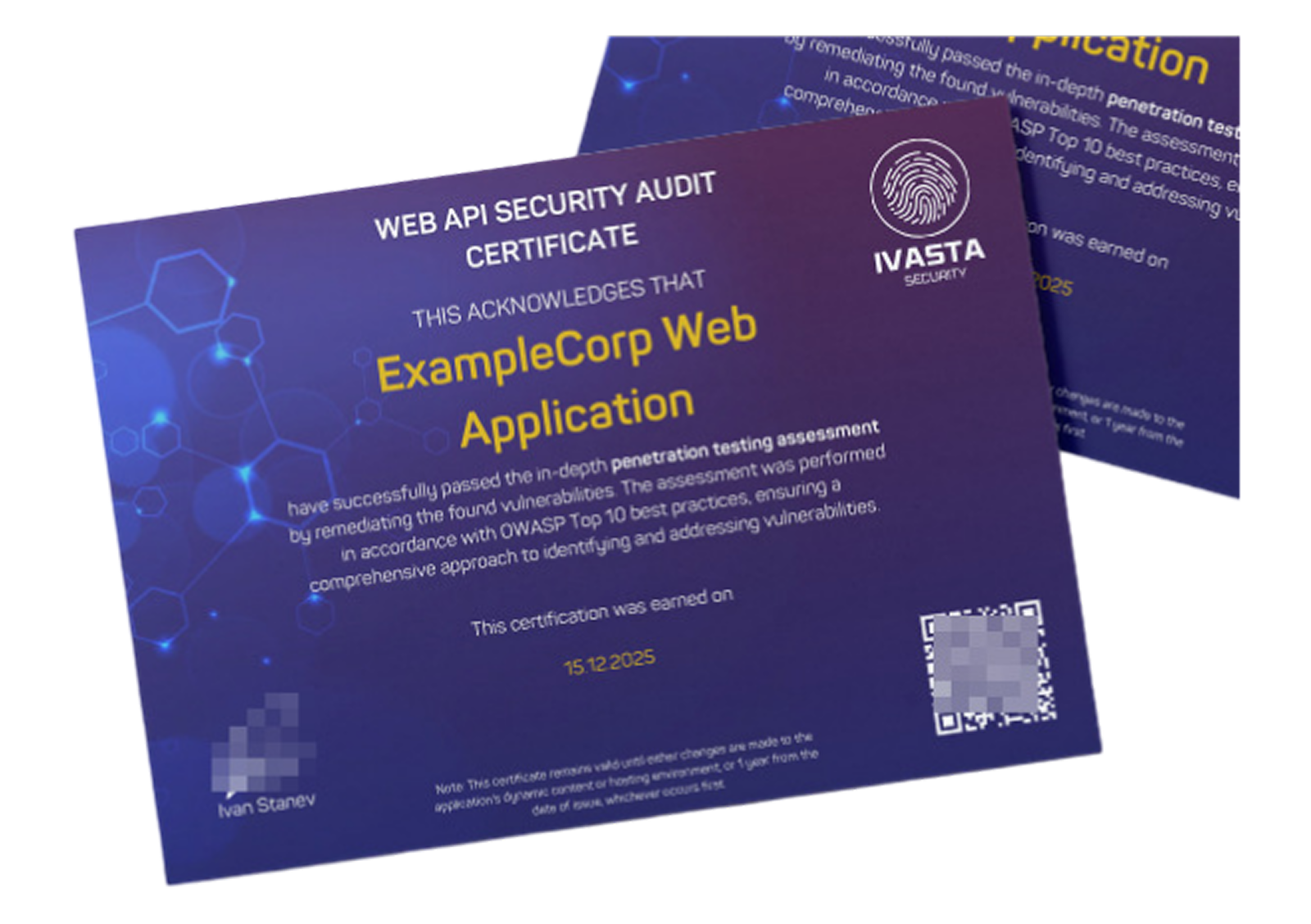
Patching a vulnerability and confirming it no longer holds under adversarial conditions are two separate things. Our optional retest assessment validates that every identified weakness has been correctly remediated and cannot be re-exploited using the original attack path or a variant. Upon successful completion, we issue a digitally signed remediation verification certificate, which provides audit-ready documentation for compliance reviewers, enterprise buyers, and internal governance requirements.
Do Not Wait for a Breach to Discover Your API Weaknesses
See What We Can Do For You
Our Methadology
Lorem ipsum dolor sit amet consectetur adipiscing eli mattis sit phasellus mollis sit aliquam sit nullam.
Lorem ipsum dolor sit amet consectetur adipiscing eli mattis sit phasellus mollis sit aliquam sit nullam.Lorem ipsum dolor sit amet consectetur adipiscing eli mattis sit phasellus mollis sit aliquam sit nullam.Lorem ipsum dolor sit amet consectetur adipiscing eli mattis sit phasellus mollis sit aliquam sit nullam.
How we keep your company secured
No complexity. Just clean, effective protection in three simple steps.
Analyze setup. Surface weaknesses instantly
The system scans your infrastructure the moment it connects, uncovering misconfigurations, outdated packages, and exposed endpoints — before attackers do.
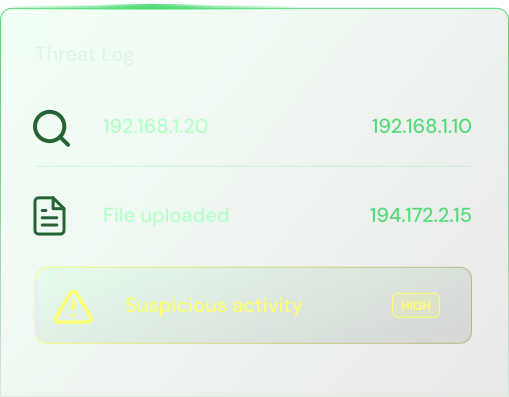
Analyze setup. Surface weaknesses instantly
The system scans your infrastructure the moment it connects, uncovering misconfigurations, outdated packages, and exposed endpoints — before attackers do.

Analyze setup. Surface weaknesses instantly
The system scans your infrastructure the moment it connects, uncovering misconfigurations, outdated packages, and exposed endpoints — before attackers do.

Frequently Asked Questions
What is API penetration testing and why does it matter?
.svg)
API penetration testing is a structured, manual-led security assessment that simulates real attacker behavior against your API endpoints, authentication systems, and business logic flows. Unlike automated vulnerability scans, API penetration testing involves certified professionals actively attempting to exploit weaknesses, chain multiple flaws together, and identify the actual damage an attacker could cause. For Enterprise companies and SaaS platforms, APIs are the primary surface through which sensitive data and core business functions are exposed, making dedicated API security testing essential rather than optional.
Why do Enterprise companies specifically need API penetration testing?
Enterprise platforms handle payment processing, identity verification, and regulated financial data through APIs that operate under strict compliance requirements and face motivated, financially incentivized attackers. A broken authorization check in a payment API or a business logic flaw in a transaction flow carries regulatory and financial consequences far beyond a typical data breach. API penetration testing for Enterprise companies is scoped to reflect this, covering payment endpoints, open banking integrations, KYC flows, and PCI DSS relevant control areas with findings documented to satisfy compliance evidence requirements.
What is the OWASP API Security Top 10 and does your testing cover it?
The OWASP API Security Top 10 is a widely referenced framework that catalogs the most critical and commonly exploited API security risks, including broken object-level authorization, broken authentication, excessive data exposure, and server-side request forgery. Our API penetration testing covers the OWASP API Security Top 10 as a baseline and extends beyond it into business logic vulnerabilities, workflow manipulation, and environment-specific attack scenarios that generic frameworks do not address. For compliance purposes, we can map findings directly to OWASP categories in the report.
How is API penetration testing different from a web application penetration test?
Web application penetration testing focuses on the full application layer including front-end interfaces, session handling, and user-facing functionality. API penetration testing is scoped specifically to the API layer, which introduces distinct risk categories including broken object-level authorization, mass assignment, and direct object reference abuse that require different testing techniques. Many organizations run both assessments because the attack surfaces only partially overlap. For API-first products and platforms where the API is the product, a dedicated API assessment provides coverage that a web application test alone cannot.
What types of APIs do you test?
We test REST, GraphQL, SOAP, and gRPC API implementations. Our scope includes public-facing APIs, partner-facing APIs, internal microservice APIs accessible from within the application environment, and mobile backend APIs. We also conduct shadow API discovery as part of the engagement to identify undocumented or deprecated endpoints that remain active and exploitable but are not included in official API documentation.
How long does an API penetration testing engagement take?
Most focused API penetration tests take between one and two weeks from testing start to final report delivery, depending on the number of endpoints, complexity of authentication flows, and whether multiple environments are in scope. Timelines are confirmed during the scoping phase so your team has accurate expectations before testing begins. Larger API surfaces covering multiple microservices or product components may require extended engagements, which are scoped and priced accordingly.
What compliance frameworks require or recommend API penetration testing?
API security testing is required or strongly recommended under PCI DSS, SOC 2 Type II, ISO 27001, HIPAA for healthcare technology platforms, and NIST 800-53. For Enterprise companies operating under FCA regulation or handling open banking data, API security assessments are increasingly expected as part of third-party risk management and vendor due diligence processes. Enterprise security questionnaires from prospective B2B buyers regularly ask for evidence of recent API-specific security testing.
How do you approach API testing without breaking production environments?
All API penetration testing is conducted within a defined rules of engagement agreed during the scoping phase. We work with your team to identify which environments are appropriate for each category of testing, how to handle high-risk techniques that could affect production stability, and what notification processes are in place if an unexpected finding requires immediate attention. Testing against production APIs is common and manageable when handled by experienced professionals operating within clear boundaries.
What does the API penetration testing report include?
Your report includes an executive summary written for non-technical stakeholders, a detailed technical findings section with reproduction steps and exploitation evidence, severity ratings based on real-world business impact rather than CVSS scores alone, and remediation guidance specific to your technology stack. For compliance engagements, findings are structured to meet third-party auditor evidence requirements. Clients who opt for the retest assessment also receive a digitally signed verification certificate confirming that identified vulnerabilities have been correctly resolved.
Can IVASTA Security test APIs on a white-label basis for audit firms and MSSPs?
Yes. We work with compliance audit firms and managed security service providers as a specialist offensive security partner on both white-label and referral arrangements. For white-label engagements, we conduct the full API penetration test and produce a report your firm delivers to your client under your own brand. The technical depth and certification credentials behind the work remain consistent regardless of the commercial arrangement. This model is well suited to audit firms that need independent, technically rigorous API security assessments to satisfy SOC 2, PCI DSS, or ISO 27001 evidence requirements for their clients.
Let's Protect Your
Business Now!