.png)
.png)
Business Logic Vulnerabilities in Web Applications: Why They Are Invisible to Scanners and How Manual Testing Finds Them

.png)
.png)
.png)
.png)
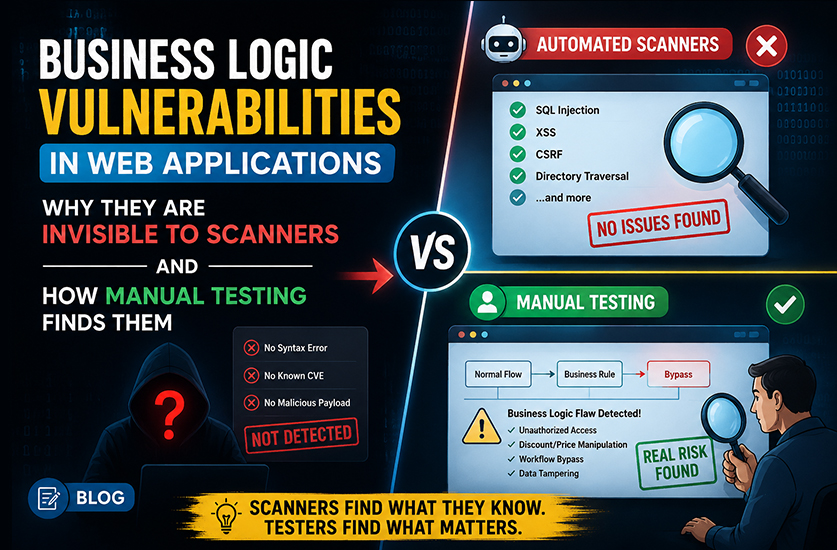
Business logic vulnerabilities are flaws in how an application enforces its own rules: payment flows that can be skipped, role boundaries that collapse under specific request sequences, multi-tenant data that leaks when the right parameter is changed. They have no CVE entry. No scanner signature. Automated tools cannot detect them because detection requires understanding how the application is supposed to work, and then testing whether it actually does.
OWASP published its first Business Logic Abuse Top 10 in May 2025, formalising ten abuse categories that have existed in production applications for years without a standard taxonomy to name them. Every category on that list requires manual testing to find. Web application penetration testing conducted by a skilled human tester is the only method that covers them. IVASTA Security's manual-first methodology directly addresses each of the ten categories through structured workflow analysis and role-based exploitation testing.
What Business Logic Vulnerabilities Are and Why They Are Different
Most application security vulnerabilities are technical defects: a buffer overflow, an unsanitised input field, a cryptographic implementation error. These are identifiable by pattern. Automated scanners are built to recognise patterns.
Business logic vulnerabilities are different in kind. They are not defects in code implementation. They are flaws in the design of the rules the application enforces. The code may execute exactly as written. The vulnerability exists because what was written does not correctly model what should happen.
A payment flow that can be completed without a valid payment authorisation token is not a code bug. It is a sequence error: the checkout endpoint does not verify that the payment step was completed before confirming the order. A multi-tenant SaaS platform that returns another organisation's records when a user modifies the account ID in an API request is not an injection flaw. It is a missing authorisation check on a business function.
These flaws are invisible to automated scanners because scanners test technical properties of requests and responses. Business logic testing requires modelling intended behaviour first, then probing whether the application actually enforces it. That is a human cognitive task, not a signature lookup.
The OWASP Business Logic Abuse Top 10 (2025): What Changed
In May 2025, OWASP published its first dedicated Business Logic Abuse Top 10, a categorised taxonomy of the most common and impactful business logic abuse classes found in production applications. This is significant for three reasons.
First, it gives security teams and auditors a shared vocabulary for a class of vulnerabilities that previously had no standard naming convention. Imagine a tester discovering that a checkout page lets users apply the same discount code twice, and separately that a password reset link never expires, two real problems with no common language to connect them or explain why both matter. The OWASP list provides that structure.
Second, it validates that business logic testing is a distinct discipline, not a subset of general web application testing. Organisations that have been relying on DAST tools to cover their web application security posture now have an authoritative document confirming that those tools do not cover this entire category.
Third, it provides a checklist that compliance teams can use to scope manual testing engagements. Rather than negotiating what a web application penetration test covers, the OWASP Business Logic Top 10 gives both parties a concrete reference for minimum expected coverage.
The full OWASP list is available at owasp.org. For teams using it to scope an engagement, IVASTA's web application penetration testing service covers all ten categories as standard scope.
Why Automated Scanners Cannot Detect Business Logic Vulnerabilities
The limitation is architectural, not a gap that future scanner versions will close. Automated scanners operate by sending crafted requests and evaluating responses against known vulnerability signatures. They test technical properties: header presence, response codes, input sanitisation, known CVE patterns.
Testing business logic requires a model of what the application is supposed to do. A scanner has no way to know that a checkout flow requires a payment confirmation before order placement, or that a user with a free tier account should not be able to access enterprise API endpoints by modifying a subscription parameter. That knowledge exists only in the application's requirements and design documentation, and in the tester's reconstruction of those rules through observation.
The Workflow Problem
Business logic flaws often span multiple requests across a multi-step workflow. The vulnerability is not in any single request but in the relationship between them: what state the application carries between steps, what it validates at each point, and what it assumes has been verified previously. A scanner that fires requests in isolation cannot test these relationships.
A manual tester maps the workflow first. They identify each step, the state transitions between them, and the assumptions each step makes about what preceded it. Then they systematically violate those assumptions: skip steps, replay tokens from earlier steps, modify state parameters, and observe whether the application enforces the expected flow or silently accepts the deviation.
The Multi-Tenancy Problem
SaaS applications with multi-tenant architectures present a specific category of business logic risk that scanners cannot evaluate. Testing whether tenant A can access tenant B's data requires two authenticated sessions in different organisational contexts, a structured approach to modifying identifiers in API requests, and the knowledge of where boundary enforcement is likely to be weakest.
For API-heavy SaaS products, API penetration testing addresses BOLA (Broken Object Level Authorisation) and mass assignment specifically as cross-tenant attack vectors, which the OWASP API Top 10 has listed as the number-one API vulnerability class since 2019.
How Web Application Penetration Testing Finds Business Logic Flaws
Manual web application penetration testing finds business logic vulnerabilities through structured analysis, not pattern matching. The process starts before any exploitation attempt.
The Role Mapping Step Most Tests Skip
The step that separates thorough business logic testing from a standard web application assessment is the initial role and workflow mapping phase. Before sending a single crafted request, the tester needs to understand what roles exist in the application, what each role can do, what each role is explicitly prevented from doing, and where the boundaries between roles are enforced.
Shortcuts at this stage produce incomplete tests. A tester who jumps directly to exploitation without mapping the role model may find a subset of authorisation failures but will miss the flaws that require understanding the full permission matrix. The OWASP Business Logic Top 10 categories BL4 (Improper Access Control in Business Flows) and BL8 (Privilege Escalation via Business Logic) are both products of incomplete role boundary testing.
Which Applications Carry the Highest Business Logic Risk
Business logic vulnerabilities exist in any application that enforces rules. The risk level correlates with the complexity of those rules, the value of the data or transactions protected by them, and the number of integration points where trust assumptions are made.
Healthcare SaaS companies handling PHI should note that HIPAA's technical safeguard evaluation requirement under 45 CFR §164.308(a)(8) applies specifically to access controls and workflows handling patient data. HIPAA penetration testing scoped to include business logic review provides the documented technical evaluation the regulation requires.
For teams preparing for SOC 2 Type II, CC6.6 covers boundary protection and logical access. A web application penetration test that includes business logic testing provides substantially stronger evidence than a scan-only assessment. See IVASTA's coverage of SOC 2 penetration testing requirements.
Scanner vs Manual: What Each Method Covers
The table below is a direct comparison of what automated DAST tools deliver versus what a manual web application penetration test delivers across the categories that matter most for business logic coverage.
Teams that want to understand the broader methodology difference before scoping an engagement can read IVASTA's comparison of vulnerability assessment vs penetration testing.
Find the Flaws Your Scanner Is Missing
If your security programme relies on DAST scanning to cover web application risk, you have a category of vulnerabilities that is not being tested. Business logic flaws, all ten categories in the OWASP 2025 list, require a human tester who maps application behaviour before probing it.
IVASTA Security conducts manual web application penetration testing that covers OWASP Business Logic Top 10 categories as standard scope. OSCP-certified testers. Written narrative reports with full exploitation chains. Fixed-price proposals within 48 hours of a scoping call.
Web Application Penetration Testing and the Business Logic Coverage Gap
The OWASP Business Logic Abuse Top 10 made something explicit that security practitioners have known for years: automated tools leave an entire category of application vulnerabilities untested. Business logic flaws require a tester who understands how an application is supposed to behave before probing whether it actually does. No scanner acquires that understanding.
For SaaS companies, fintech platforms, and healthcare applications, the business logic layer is often where the most sensitive data and the most valuable transactions are protected. Relying on DAST scanning alone to assess that protection is a material gap in security posture.
Web application penetration testing that covers the OWASP Business Logic Top 10 is the right scope for any application where logic-layer flaws would have material business consequences. IVASTA Security provides this coverage as standard scope, with OSCP-certified testers and fixed-price proposals within 48 hours of scoping. To get started, contact IVASTA Security here.