
.png)
.png)
Vulnerability Assessment vs Penetration Testing in 2026: The Definitive Guide for CTOs and CISOs

.png)
.png)
.png)
.png)
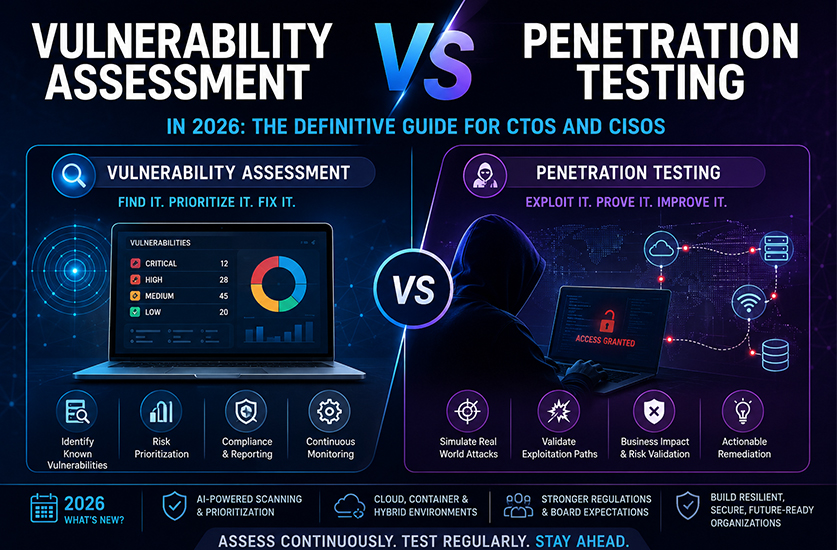
- A vulnerability assessment identifies and catalogues known weaknesses using automated scanning. A penetration test exploits those weaknesses manually to measure real attack impact.
- Automated scanners cannot test business logic, chain vulnerabilities, or simulate a real attacker's decision-making. Manual testing covers all three.
- PCI DSS v4.0 requires both: quarterly scanning (Req 11.3.1) and annual manual pen test (Req 11.3.2). SOC 2 CC6.6, HIPAA §164.308(a)(8), and FedRAMP CA-8 require penetration testing specifically.
- The average cost of a data breach reached $4.88 million in 2024 (IBM). The cost of a thorough penetration test is a fraction of one incident.
- Most SaaS, fintech, and healthcare companies need both methods at different intervals: continuous or quarterly vulnerability assessment, and annual penetration testing with targeted retests after major changes.
- IVASTA Security conducts manual penetration tests across web applications, APIs, cloud infrastructure, and network environments with OSCP-certified testers, not automated scan exports.
What Is a Vulnerability Assessment?
A vulnerability assessment is a systematic process of identifying, classifying, and prioritising security weaknesses in a system or network. It relies primarily on automated scanning tools that compare your environment against databases of known vulnerabilities, including CVE entries, CIS benchmarks, and vendor security advisories.
The output is a prioritised list: assets scanned, vulnerabilities found, CVSS severity scores, and recommended patches or configuration changes. A well-executed vulnerability assessment tells you what is exposed. It does not tell you whether any of it is actually exploitable in your environment.
A vulnerability assessment is the right tool for broad, repeatable coverage across a large asset inventory. It is not the right tool for understanding what happens after an attacker gets a foothold.
What Is a Penetration Test?
A penetration test is an authorised simulation of an attack against your systems. A skilled tester, working within a defined scope and rules of engagement, attempts to exploit vulnerabilities the way a real attacker would: escalating privileges, pivoting between systems, bypassing authentication controls, and chaining individually low-severity findings into high-impact attack paths.
The value of a penetration test is not the list of findings. It is the answer to the question: if an attacker got into this system, how far could they go, and what would they reach?
Manual penetration testing requires expertise that scanners cannot replicate. Business logic flaws, authentication bypass chains, insecure direct object references (IDOR), and chained privilege escalation paths are invisible to automated tools. They only surface when a human tester actively probes the application the way an adversary would.
IVASTA Security's
IVASTA Security's web application penetration testing and API penetration testing engagements are conducted entirely by OSCP-certified testers. No scan export wrapped in a report template.
Vulnerability Assessment vs Penetration Testing: Side-by-Side Comparison
The table below covers the practical differences that matter when you are deciding which method to use, when to use it, and what to expect from the deliverable.
Why a Vulnerability Assessment Alone Is Not Enough
Automated scanners are good at finding what is already in a CVE database. They are poor at finding what is not. Application-layer flaws specific to your codebase, misconfigured trust relationships between microservices, and authentication logic that works in isolation but fails under adversarial conditions all fall outside the scanner's reach.
The Chaining Problem
A real attacker does not exploit one critical vulnerability. They chain a sequence of medium-severity findings that individually look manageable. A misconfigured S3 bucket that leaks an API key is a medium finding. An API key that can assume an IAM role with administrative access is another medium finding. Together they are a full compromise. Automated scanning scores each finding independently. Manual penetration testing finds the chain.
Business Logic Flaws
Business logic vulnerabilities do not appear in CVE databases because they are specific to your application. A checkout flow that skips authorisation checks on coupon redemption, a multi-tenant SaaS platform that leaks records across organisational boundaries under specific query conditions, or a file upload handler that processes server-side templates are all invisible to scanners. They require a tester who understands how the application is supposed to work in order to find where it does not.
For SaaS products handling sensitive data, manual penetration testing is the method that catches what scanners systematically miss.
When Should You Run Each? A Decision Guide
The right choice depends on your compliance obligations, your current risk posture, and what changed in your environment recently. The table below maps common situations to the appropriate method.
Compliance Requirements: What Each Framework Actually Mandates
The compliance question comes up on every engagement scoping call. The short answer: most frameworks that mention security testing mean penetration testing, and several require both methods explicitly.
For teams preparing for a SOC 2 audit, see IVASTA's guide to SOC 2 penetration testing requirements. For HIPAA-covered healthcare SaaS, the technical evaluation requirement under §164.308(a)(8) maps directly to an annual penetration test of the infrastructure and application handling PHI.
Healthcare SaaS teams can read more about scoping in IVASTA's HIPAA penetration testing guide.
What a Good Report Looks Like: VA vs Pen Test Deliverables
The deliverable is where the practical difference between the two methods becomes concrete. A vulnerability assessment report is a structured list. A penetration test report is a narrative. Both have value, but they answer different questions. Our sample penetration test report.
How to Choose the Right Penetration Testing Partner
Not every firm that offers penetration testing is conducting manual tests. Several deliver DAST scanner output with a cover page. Before signing a statement of work, ask these questions directly.
- Who conducts the test? Ask for the tester's credentials. OSCP is the baseline for offensive security work. OSEP and CRTO indicate more advanced adversary simulation capability.
- Is the methodology manual, automated, or both? A credible answer names specific manual techniques used: business logic review, authentication bypass testing, chained privilege escalation. A vague answer is a signal.
- What does the report include? Ask to see a redacted sample report. If it reads like a scanner export, it probably is one.
- Is retest included? Remediation without verification is half the work. Any serious firm includes at least one retest cycle for critical and high findings.
- How is scoping handled? Scope defines what the test covers and what it cannot. A competent firm does a scoping call before quoting, not after.
IVASTA Security publishes its methodology and tester credentials upfront. Review the IVASTA Security penetration testing services page for scope categories and sample deliverable structure.
Ready to Move Beyond Scanning?
A vulnerability assessment tells you what is listed in a database. A penetration test tells you what an attacker would actually do with it. If your compliance window is approaching, your architecture has changed, or you have never had a manual test conducted on your production environment, now is the right time to scope one.
IVASTA Security conducts manual penetration tests across web applications, APIs, cloud infrastructure, and internal networks. OSCP-certified testers. Fixed-price proposals within 48 hours of a scoping call. Retest access included for critical and high findings.
Vulnerability Assessment vs Penetration Testing: The Bottom Line
Vulnerability assessments and penetration tests are not competing methods. They answer different questions at different depths, and most organisations that take security seriously use both. Scanning gives you coverage. Manual penetration testing gives you the answer to the question that actually matters: could an attacker get in, and if they did, what could they take?
If your last security test was a scanner export, you know what is in a CVE database as of the scan date. You do not know whether any of it is exploitable in your specific environment, whether your authentication logic holds under pressure, or whether your cloud IAM configuration can be pivoted against you.
IVASTA Security provides manual penetration testing for SaaS, fintech, and healthcare companies across the United States and Europe.
To discuss scope and receive a fixed-price proposal, schedule a scoping call with IVASTA Security.