.png)
.png)
AI Agent Penetration Testing: A Practical Security Methodology

.png)
.png)
.png)
.png)
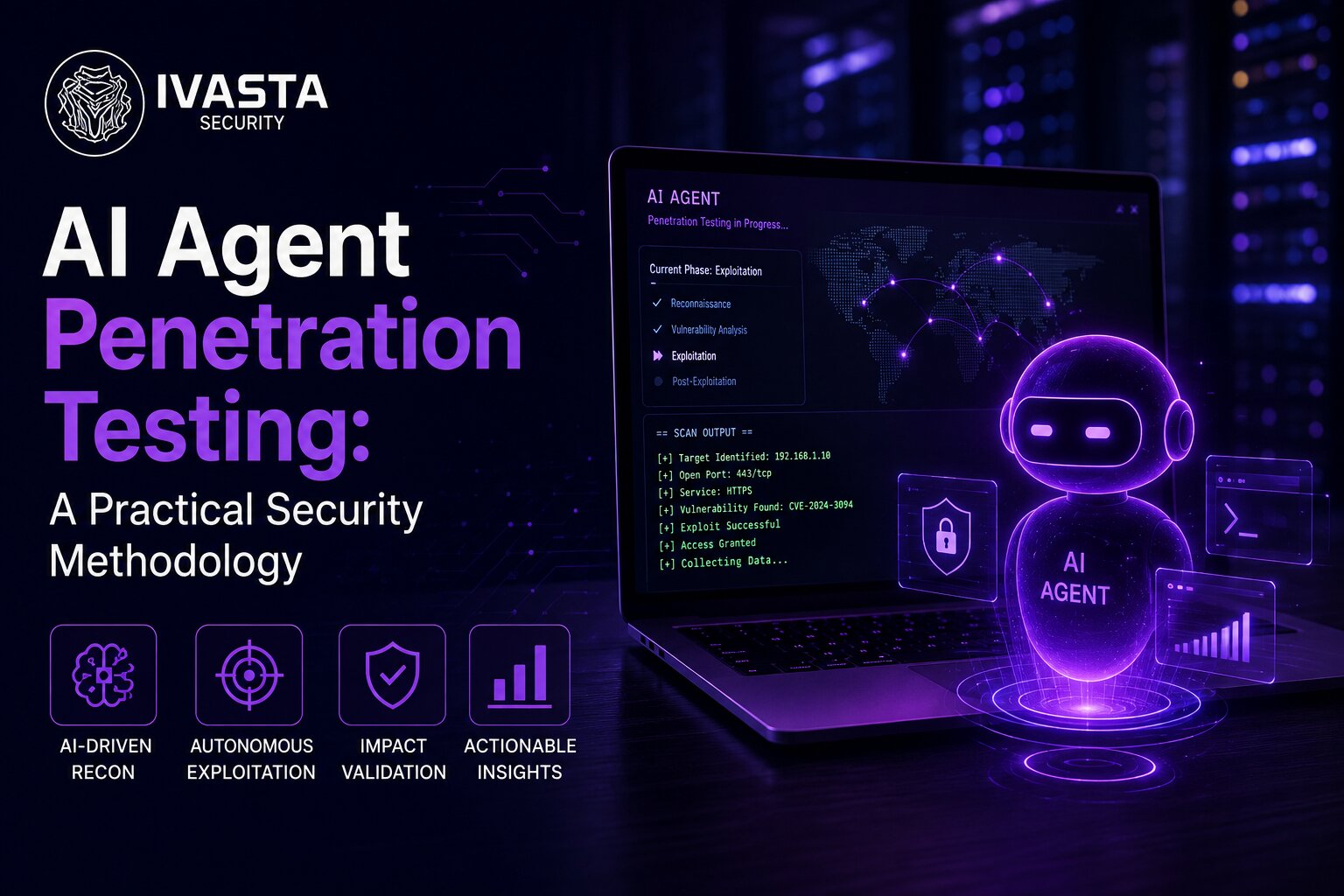
If you are a SaaS founder integrating large language models or autonomous agents into your product, here is the condensed version: yes, AI agents can and must be penetration tested, and the methodology is significantly different from anything your team has run before. Standard web application penetration testing for SaaS startups covers OWASP vulnerabilities, authentication bypass, business logic flaws, and injection paths. All of that still applies. But when an AI agent sits in your stack with access to tools, external APIs, and a reasoning engine that adapts its own behavior, the attack surface expands in ways that traditional testing frameworks were never designed to handle. Modern AI-agent assessments can draw on resources such as the OWASP Top 10 for Agentic Applications, the OWASP Top 10 for LLM Applications, and relevant NIST AI security guidance, while adapting testing to the architecture and business logic of the specific product. AI LLM security penetration testing for tech startups addresses exactly that expanded surface, and combining both disciplines is now the baseline expectation for any AI-native product that wants to sell to enterprise buyers or pass a SOC 2 audit.
Why SaaS Startups with AI Agents Face a Compounded Security Problem
The SaaS security conversation used to be manageable. You scoped your web app, tested authentication, validated your API endpoints, covered multi-tenant isolation, and walked away with a report your auditors could action. Web application penetration testing for SaaS startups built around that framework has served the industry well. The problem is that AI agents break the assumptions underneath it.
An AI agent does not behave like a web application. It plans. It decides which tools to invoke. It retrieves context from memory stores and adapts its actions based on what it finds. It can call your internal APIs, write to databases, trigger webhooks, and send communications on behalf of users. When a tester probes a conventional SaaS application, the system responds predictably to inputs. When a tester probes an AI agent, the response path is non-deterministic — the same input can produce different action chains depending on context, memory state, and how the model interprets its current goal. That unpredictability is what makes AI LLM security penetration testing for tech startups a distinct discipline, not a subset of web app testing.
The compounded risk for SaaS founders is that your web application penetration testing covers the application layer but leaves the agent layer entirely untested unless the engagement is explicitly scoped to include it. That gap is where motivated attackers are starting to look.
The Unique Attack Surface of Agentic AI Systems
Before walking through a testing methodology, it is worth mapping the territory. Agentic systems introduce attack surfaces that have no equivalent in a conventional SaaS product. A tester conducting web application penetration testing for SaaS startups can work from established frameworks like the OWASP Top 10 because web apps follow predictable patterns. Agentic systems require a different map entirely.
Table 1: Agentic AI attack surfaces not covered by standard web application penetration testing
A Practical Penetration Testing Methodology for AI Agents
The methodology below represents how IVASTA Security approaches engagements that combine web application penetration testing for SaaS startups with AI LLM security penetration testing for tech startups. The two are not sequential — they are integrated. A finding in the agent layer often has dependencies in the application layer and vice versa.
Phase 1: Integrated Scoping
Scoping an engagement that covers both the SaaS application and the AI agent layer requires more preparation than a standard web application assessment. Testers need to understand which tools the agent can invoke, what external services it connects to, what data stores it reads and writes, and what the agent's goal structure looks like under normal operating conditions. They also need to understand your application's standard attack surface: authentication flows, session management, multi-tenant isolation controls, and API endpoint coverage.
This scoping conversation is where AI LLM security penetration testing for tech startups diverges most sharply from a conventional engagement. The rules of engagement must explicitly address which agent capabilities are in scope, whether testing covers production or a staging environment, and what constitutes a destructive action that requires human approval before the tester proceeds. Getting this wrong leads to either missed coverage or unintended impact on live systems.
Phase 2: Application Layer Assessment
The foundation of any SaaS security engagement remains the application layer. Testers conduct web application penetration testing for SaaS startups covering authentication and session handling, multi-tenant data isolation, business logic manipulation, authorization bypass scenarios, client-side vulnerabilities, and injection paths. This phase applies OWASP Top 10 methodology as a baseline and extends into product-specific abuse scenarios that automated scanners consistently miss.
For SaaS products with AI features, the application layer assessment also maps every interface through which user inputs reach the LLM or agent. Those interfaces become the entry points for the subsequent AI-specific testing phases. API penetration testing runs in parallel, covering every endpoint the agent can invoke as well as those exposed to external users — because the agent's tool access and your users' API access often share the same underlying infrastructure.
Phase 3: Prompt Injection and Goal Hijacking
Prompt injection is to AI agents what SQL injection was to early web applications — a foundational vulnerability class capable of producing catastrophic outcomes at scale. In AI LLM security penetration testing for tech startups, testers craft adversarial inputs designed to override the agent's system instructions, inject false context into its reasoning process, or redirect its planned actions toward attacker-controlled objectives. Both direct injection through user-facing interfaces and indirect injection through data the agent retrieves from external sources are in scope.
A particularly important variant for SaaS products is indirect prompt injection through user-generated content. If your agent processes documents, emails, or database records on behalf of users, any of that content can carry embedded instructions that manipulate the agent's behavior. This vector is missed entirely by standard web application penetration testing for SaaS startups because the application layer looks clean while the agent layer is wide open.
Phase 4: Memory and RAG Pipeline Testing
Many SaaS AI products use retrieval-augmented generation architectures to give agents access to product knowledge, user history, or operational data. The vector database or retrieval pipeline feeding the agent is itself an attack surface. AI LLM security penetration testing for tech startups that includes RAG-based products must specifically test whether malicious content injected into the knowledge base can steer agent outputs, expose sensitive data from other tenants, or cause the agent to retrieve and act on instructions it should not follow.
Memory poisoning in multi-tenant SaaS products carries a specific risk profile that goes beyond individual user impact. If one tenant's data can influence an agent's behavior toward another tenant's session, you have a data isolation failure that standard web application penetration testing for SaaS startups would detect at the application layer but miss entirely at the agent layer.
Phase 5: Tool Adapter and Integration Exploitation
An agent's power comes from its ability to act through tools — calling APIs, writing to databases, sending emails, executing code. Each tool the agent can invoke carries its own exploitable attack surface. Testers examine whether the agent can be manipulated into invoking tools outside its permitted scope, whether authentication and authorization checks hold under adversarial prompting, and whether tool responses can themselves be crafted to carry injection payloads.
For SaaS startups, the tool adapter layer is frequently built quickly by engineering teams whose primary focus is capability velocity rather than security posture. The cloud security assessment layer addresses infrastructure-level exposure. Tool adapter testing in an AI engagement addresses the agent-specific abuse scenarios that infrastructure testing cannot reach.
Phase 6: Validation, Reporting, and Remediation
Every finding is manually validated before it appears in the final report. A credible AI LLM security penetration testing for tech startups report goes beyond listing vulnerabilities — it documents the complete attack chain, the conditions required to exploit each finding in your specific product context, and remediation steps your engineering team can implement without needing to decode security jargon. For web application penetration testing for SaaS startups, the report is structured to satisfy SOC 2 Type II evidence requirements and provide actionable severity prioritization based on real-world business impact rather than raw CVSS scores.
Standard SaaS Testing vs. Integrated AI Agent Testing
What SaaS Founders Get Wrong About AI Security Testing
The most common mistake SaaS founders make is treating AI LLM security penetration testing for tech startups as a separate engagement to be scheduled after the product is stable. In practice, the AI layer and the application layer share infrastructure, shared authentication surfaces, and shared data stores. Testing them independently misses the chained vulnerabilities that exist at their intersection.
The second mistake is assuming that a clean result from standard web application penetration testing for SaaS startups means the product is secure. It means the application layer is secure under conventional testing assumptions. An agent layered on top of a clean application can still be manipulated into exfiltrating data, bypassing authorization controls, or performing destructive actions — because those manipulation paths run through the agent's reasoning process, not through the application's input handlers.
A third pattern worth addressing: model provider security is not product security. The model your agent uses may be well-hardened at the provider level. Your product's system prompt design, tool access configuration, memory architecture, and user input handling are your responsibility. AI LLM security penetration testing for tech startups tests exactly those product-layer decisions — and that is where the most consequential vulnerabilities are consistently found.
When to Run This Testing and What to Expect
The right time to start is before your AI features reach production users, particularly enterprise customers who will conduct their own security reviews. A pre-launch engagement covering both web application penetration testing for SaaS startups and the AI agent layer puts you in a position to address findings before they become incident reports. It also gives your sales team documented evidence of a completed security assessment — which enterprise procurement teams increasingly require before signing a contract.
Any significant change to your agent's tool access, system prompt, or memory architecture should trigger a targeted retesting cycle. These changes alter the agent's behavior surface in ways that prior assessments do not cover. The vulnerability assessment you run on your infrastructure baseline is a separate, complementary process — not a substitute for agent-specific security testing.
For startups approaching SOC 2 Type II, it is worth noting that auditors are increasingly asking about AI component security as part of vendor management and change management controls. A completed AI LLM security penetration testing for tech startups engagement produces evidence that directly supports those controls. It also positions your team to answer the security questionnaires that arrive from enterprise buyers with confidence rather than improvisation.
Why Human-Led Testing Remains the Core Requirement
Automated scanning tools were not designed to test the reasoning behavior of AI agents. They can surface known CVEs in dependencies and flag obvious misconfigurations, but they cannot simulate how a motivated attacker would manipulate an agent's goal structure, poison its memory retrieval, or chain tool invocations to achieve unauthorized outcomes. Those attack patterns require human intuition, creative adversarial thinking, and an attacker's understanding of how the specific product is designed to work.
IVASTA Security's team carries OSCP, OSCP+, OSEP, OSWE, and CREST credentials and approaches every AI LLM security penetration testing for tech startups engagement with a genuine attacker's mindset rather than a checklist. For web application penetration testing for SaaS startups, that same adversarial approach consistently uncovers business logic flaws and multi-step exploitation paths that automated tools miss entirely. Pairing both methodologies in a single integrated engagement is how SaaS companies with AI features get a complete picture of their actual exposure — not just a snapshot of their documented attack surface.
Startups that want to build products enterprise buyers will trust need security evidence that covers both layers. The web application penetration testing engagement handles the foundation. The AI agent assessment extends coverage to the reasoning and tool-access layer. Together, they give your security program the depth it needs to withstand scrutiny from auditors, enterprise procurement teams, and the attackers who will inevitably probe your product once it is live.
Ready to test your AI agent before a threat actor does it for you? Book a free scoping call with IVASTA Security and we will map your actual exposure across both the application and agent layer before making any recommendation.