
.png)
.png)
How to Choose a Penetration Testing Partner for Compliance Audit Firms: A 12-Point Vetting Checklist

.png)
.png)
.png)
.png)
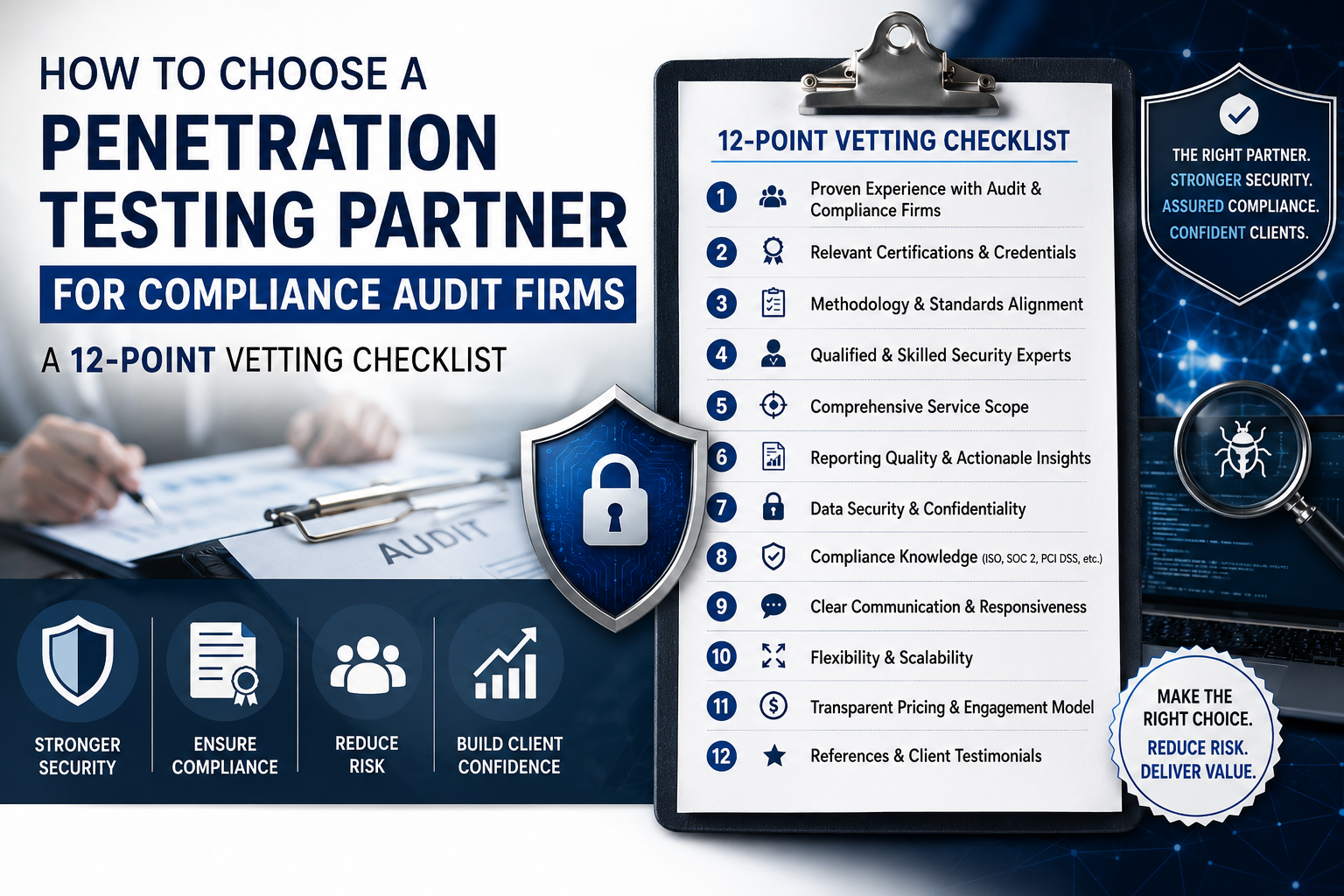
Choosing the right penetration testing partner for compliance audit firms is one of the most consequential decisions a practice leader will make when expanding into security services. Get it wrong and you are handing a client a scanner-generated report disguised as expert-level manual testing is a mistake that surfaces quickly when the findings fail to satisfy a SOC 2 auditor or collapse under scrutiny from a QSA. Get it right and you gain a delivery partner who strengthens your assurance offering, protects your firm's reputation, and generates a recurring revenue stream with zero internal headcount. The short version of this checklist: verify tester certifications before anything else, demand a sample report, and confirm that 100% of findings are manually validated. The twelve points below give you everything else you need to pressure-test any candidate.
Why the Vetting Process Matters More Than the Price Sheet
Most audit firms that have had a poor experience with a penetration testing partner will trace the problem back to one of three root causes. The partner overstated their manual testing capability and delivered automated scanner output. The partner lacked genuine understanding of the compliance frameworks the audit client was trying to satisfy. Or the partner had no experience working within the structured, brand-sensitive environment that an audit firm requires.
None of those failures announce themselves on a provider website. Every security testing firm claims expertise, manual methodology, and compliance experience. The vetting process is how you separate the genuine penetration testing partner for compliance audit firms from the generalists who have rebranded their standard offering for the audience. This checklist gives you twelve specific areas to interrogate, with concrete questions and clear red flags at each stage.
The 12-Point Vetting Checklist at a Glance
Deep Dive: What Each Checkpoint Actually Involves
1. Verify Individual Tester Certifications, Not Company Credentials
The single most reliable quality signal when evaluating a penetration testing partner for compliance audit firms is the certification profile of the actual testers who will be assigned to your engagements. Company-level accreditations tell you about commercial standing; individual certifications tell you about technical capability.
OSCP (Offensive Security Certified Professional) should be the floor, not the ceiling. It is the only certification in the industry that requires candidates to compromise real systems within a 24-hour window without assistance, a direct proxy for hands-on exploitation skill. Partners whose testers hold OSCP alongside advanced credentials such as OSEP, CREST CCT, or GXPN give you meaningful depth. Partners who cite CEH as their primary credential are describing foundational knowledge, not operational competency. Always ask to see the specific certifications of the testers assigned to your account, not a roster of what the company holds in aggregate.
2. Confirm Compliance Framework Coverage Across SOC 2, PCI DSS, and ISO 27001
As a penetration testing partner for compliance audit firms, the provider must understand the compliance environments your clients operate within. That means more than a passing familiarity with SOC 2. It means knowing which Trust Services Criteria a penetration test supports, how testing timing aligns with a Type II audit period, what PCI DSS v4.0 Requirement 11.4 mandates for testing cadence and scope, and how ISO 27001 Annex A controls translate into testing objectives.
Ask the provider to walk you through how they would scope a penetration test for a client simultaneously pursuing SOC 2 Type II certification and PCI DSS compliance. Their answer tells you whether they understand the distinct requirements of each framework or whether they apply a generic scope and attach compliance language to the report afterward. The latter approach produces reports that compliance officers and auditors will push back on.
3. Request a Sample Report Before Any Conversation About Pricing
The penetration test report is what your audit client presents to their board, their regulator, and their auditor. It carries your firm's implicit endorsement the moment you introduce the engagement. A sample report reveals more about a penetration testing partner for compliance audit firms than any sales conversation.
What you are looking for: findings presented with full exploitation evidence rather than scanner CVE identifiers, remediation guidance that is specific enough for a developer to act on without further research, risk ratings that reflect business impact rather than purely technical CVSS scores, and a compliance mapping section that ties each finding to the relevant framework controls. What you are not looking for: findings that read like automated Nessus or Burp Suite output, generic remediation text that is not environment-specific, and a report structure that cannot serve both a technical team and a compliance officer without supplemental documentation.
IVASTA Security makes a sample penetration testing report available without requiring a sales conversation, a useful benchmark when comparing provider report quality.
4. Confirm White-Label Delivery Capability and Branding Flexibility
When you introduce a penetration testing partner to an existing audit client, the client's experience of that engagement reflects on your firm regardless of who performs the testing. White-label delivery where reports and communications carry your firm's brand rather than the testing partner's protects that relationship and maintains the seamless service experience your clients expect.
Not every provider offers genuine white-label capability. Some provide a logo swap on a standard template; others build delivery workflows designed to keep the testing partner invisible throughout. The latter is what you want. Ask specifically how client-facing communications are handled during the active testing window, whether the tester introduction email comes from your firm's domain, and whether the final report can be fully re-branded including headers, footers, and contact information.
5. Probe the Testing Methodology in Detail
Any credible penetration testing partner for compliance audit firms should be able to walk you through their testing methodology in enough detail that you can form a view on its depth and rigour. The methodology question is designed to surface the difference between providers who conduct genuine adversarial testing and those who run tooling against a target and document the output.
Ask how they approach business logic testing in web applications, a category that scanners cannot address. Ask what manual techniques they use for privilege escalation in internal network assessments. Ask how they validate that a finding is exploitable rather than theoretical. Providers who give specific, technically grounded answers are describing actual practice. Providers who respond with framework names and generic assurances are describing aspirations. See how IVASTA Security approaches manual penetration testing versus automated scanning for a detailed comparison of what the distinction means in practice.
6. Ask for Evidence of Prior Audit Firm Partnership Experience
There is a meaningful difference between a provider who has delivered penetration testing to enterprise clients and one who has operated as a penetration testing partner for compliance audit firms. The audit firm context introduces specific requirements that direct enterprise delivery does not: white-label brand management, coordination with audit timelines rather than project timelines, three-way communication involving the audit firm, the client, and the testing partner, and report structures designed for auditor consumption.
Ask directly whether the provider has existing relationships with audit or compliance advisory firms. Ask for an anonymised description of how those engagements are structured. A provider who has navigated the audit firm model before will give you a detailed, confident answer. One who has not will give you a theoretical response about being flexible and accommodating.
7. Confirm the Manual Validation Rate for All Findings
This is the most operationally significant question on the checklist. The percentage of findings that receive manual validation before appearing in a client report is a direct measure of testing quality and the reliability of the output your audit clients will receive.
Ask the provider: what percentage of findings in your reports are manually validated by a tester before inclusion? The correct answer is 100%. Any answer below that means scanner findings are making their way into reports without human verification which means false positives, incorrect severity ratings, and findings that fail to survive scrutiny from a developer or a QSA. The compliance audit context makes this particularly important. A finding that is challenged and retracted during an audit review reflects on the audit firm that introduced the engagement, not just the testing partner that delivered it.
8. Understand Escalation and Communication Protocols
Penetration tests occasionally surface critical vulnerabilities that require immediate attention active exploit paths to sensitive data, exposed credentials, or misconfigurations that could be leveraged before remediation. Your penetration testing partner for compliance audit firms needs a defined escalation process for precisely these scenarios.
Ask how critical findings are communicated. Is it an automated alert, a direct call to the lead contact, a notification through a client portal? Ask what the expected response time is for critical finding notification outside business hours. Ask how the partner handles the situation if a critical finding is identified during an audit engagement where the client's compliance timeline is immovable. A partner without clear answers to these questions introduces operational risk that is difficult to manage once an engagement is underway.
9. Verify Insurance Coverage and Contractual Liability Provisions
Professional liability insurance (errors and omissions) and cyber liability coverage are standard commercial requirements for any mature penetration testing partner. Their presence signals financial stability and accountability; their absence should raise concerns about commercial maturity regardless of how impressive the technical credentials appear.
Request a certificate of insurance showing current coverage and coverage limits before formalising any partnership arrangement. Review the contractual indemnification provisions carefully, specifically the allocation of liability between your firm, the testing partner, and the client in scenarios where testing causes unexpected service disruption or data exposure. Engage legal counsel to review the partnership agreement rather than relying on the testing partner's standard terms.
10. Request References Specifically from Audit or Compliance Delivery Contexts
References from direct enterprise clients are useful but not sufficient validation for the audit firm partnership context. What you need are references from other audit, compliance advisory, or professional services firms that have used the provider as a penetration testing partner for compliance audit firms in a white-label or co-delivery model.
When speaking to references, ask specifically about report quality and auditor acceptance rates, communication during active engagements, how the provider handled any issues or escalations, and whether they would introduce the provider to additional audit clients. Recent references from the past twelve months are significantly more valuable than historical ones, as team composition and service quality can shift considerably over that period.
11. Clarify Turnaround Times and Delivery SLAs
Audit timelines are not flexible. When a client's SOC 2 Type II period closes or a PCI QSA assessment begins, the penetration testing report needs to be in hand and ready for evidence submission. A partner who cannot commit to defined delivery SLAs is incompatible with compliance-driven delivery schedules regardless of their technical quality.
Standard delivery timelines for a web application penetration test run between seven and ten business days from kickoff to final report. Infrastructure and network assessments may run ten to fifteen business days depending on scope. Ask explicitly whether the partner can accommodate compressed timelines for compliance deadline situations, and whether expedited delivery carries a premium. Establish SLAs in writing before the first engagement rather than relying on informal assurances.
12. Assess Long-Term Partnership Orientation Beyond the First Engagement
The most valuable penetration testing partner for compliance audit firms relationships compound over time. A partner who maintains knowledge of a client's environment from one engagement to the next delivers more targeted testing, identifies regression vulnerabilities more efficiently, and spends less time on scope discovery that was already completed.
Ask what support the provider offers between formal engagements. Do they share relevant threat intelligence? Do they provide remediation guidance when developers raise questions about specific findings? Do they proactively flag when a new vulnerability class emerges that is relevant to a client's technology stack? Partners who do these things view the relationship as ongoing rather than transactional. That orientation is what turns a vendor arrangement into a genuine penetration testing partner for compliance audit firms, one whose success is tied to yours.
Scoring Your Candidates: A Weighted Evaluation Framework
Not every vetting point carries equal weight for every audit firm. The table below provides a suggested scoring framework that audit practices can adapt based on their specific client base, compliance specialisation, and partnership priorities. Score each candidate against each category on a 1 to 5 scale and multiply by the weight to produce a weighted total.
A candidate scoring 85 or above out of 100 across this framework warrants serious consideration. Any candidate who scores a 1 on Tester Certifications or Manual Validation Rate should be eliminated from the shortlist regardless of their overall score these two factors are foundational and cannot be compensated for by strength elsewhere.
How to Use This Checklist in a Live Evaluation
Run the checklist as a structured evaluation rather than a free-form conversation. Send the twelve questions to candidates in advance and ask them to respond in writing before a follow-up call. Written responses reveal how much thought a provider has given to the penetration testing partner for compliance audit firms model and how much of their answer is being constructed on the fly.
During the follow-up call, probe the answers that were vague or generic. Ask for specific examples. Request a list of the certifications held by the testers who would be assigned to your account. Ask to see the actual escalation procedure document rather than a verbal description of it. The providers who can answer in specifics are the ones with genuine operational depth; the ones who redirect to high-level positioning are telling you something important.
For audit firms working with clients across web application penetration testing or API penetration testing requirements, it is worth requesting a scoping questionnaire from each candidate as part of the evaluation. How a provider scopes an engagement reveals their understanding of the client's environment and their ability to translate audit context into a testing programme that satisfies both technical and compliance objectives.
Once you have shortlisted two or three candidates, run a pilot engagement on a contained scope before committing to a full partnership. The pilot does not need to be large; a single web application or a defined internal network segment is sufficient. What you are evaluating is delivery quality, communication, report format, and professionalism throughout the engagement lifecycle. The findings from a pilot tell you more than any reference call or sales conversation.
Want to see how IVASTA Security performs against this checklist? Reach out to our team and we will walk you through our methodology, certifications, and white-label delivery model on a no-obligation call.