.png)
.png)
Prompt Injection Is Just the Beginning: 7 AI Security Risks Most Startups Ignore

.png)
.png)
.png)
.png)
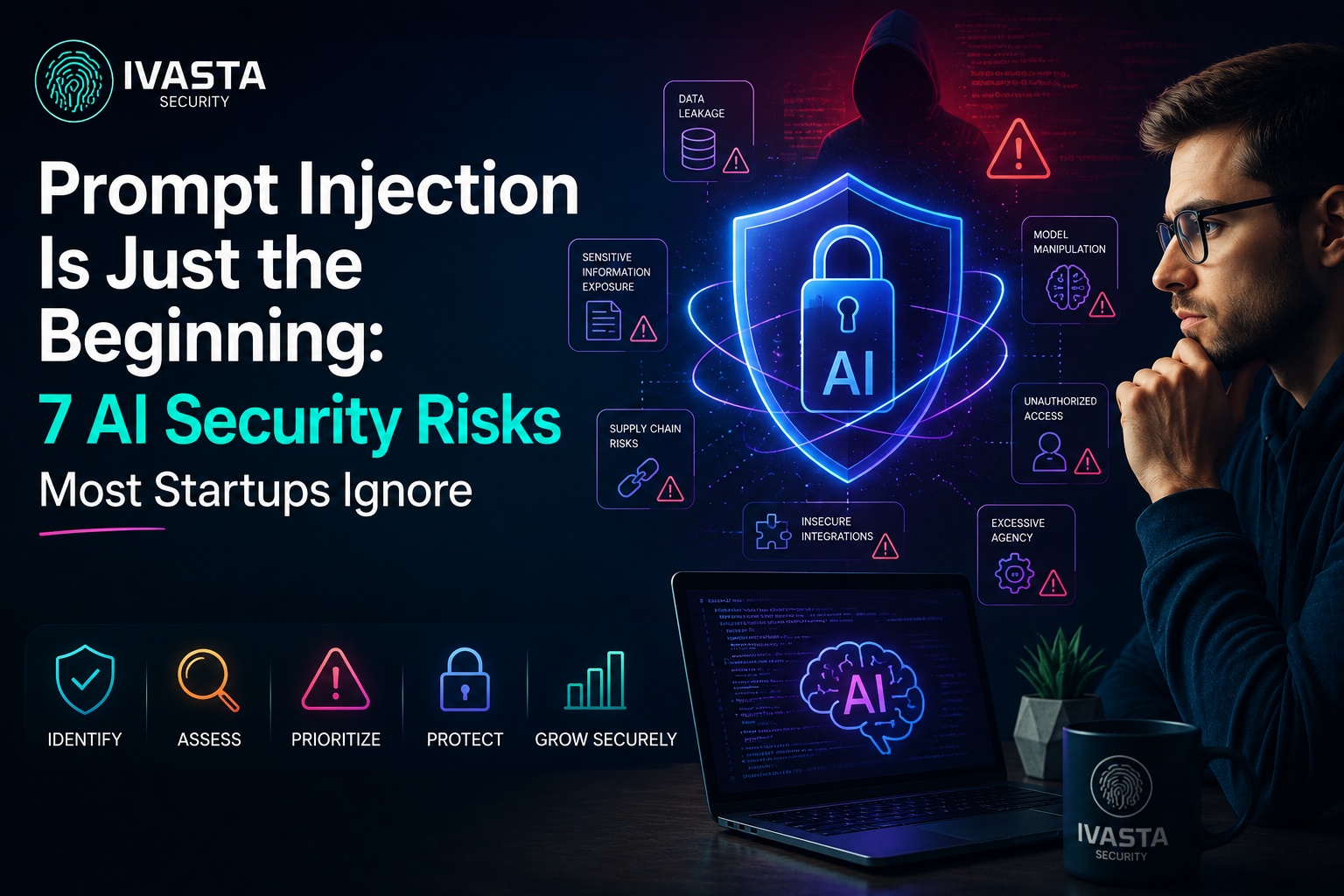
Every security conversation about AI products starts with prompt injection. And while that focus is warranted - OWASP ranks it as the number one vulnerability class for large language models - treating it as the only risk worth worrying about is the kind of thinking that turns a manageable security posture into a breach waiting to happen. AI LLM security penetration testing for tech startups surfaces seven distinct vulnerability classes, and prompt injection is merely the one attackers talk about most openly. The other six tend to be discovered during web application penetration testing for SaaS startups that includes AI components - or, more commonly, they are discovered through incidents after the product has shipped. This blog covers all seven, what makes each one dangerous specifically for startup-stage products, and how to build a testing program that actually finds them before they find you.
Why Startups Are Disproportionately Exposed to AI Security Risk
Enterprise security teams have the budget to run layered defenses, dedicated red team exercises, and continuous monitoring. Startups ship fast, integrate LLMs because the capability is genuinely useful, and often treat security as a task to schedule for next quarter. That gap between deployment velocity and security maturity is exactly what makes AI LLM security penetration testing for tech startups so urgent at the early stage. The attack surface expands the moment an AI component goes live. It does not wait for your SOC 2 audit.
The same applies to web application penetration testing for SaaS startups. A conventional SaaS product has a defined, largely predictable attack surface. Add an LLM with tool access, memory retrieval, and user-controlled inputs, and you have introduced a reasoning layer that standard application testing frameworks were not designed to probe. What follows are the seven risks that comprehensive AI LLM security penetration testing consistently surfaces in startup-stage AI products.
Risk 1: Prompt Injection - Direct and Indirect
Prompt injection is the vulnerability class every founder has heard of and most have underestimated in scope. Direct injection happens when a user crafts an adversarial input that overrides the model's system instructions - instructing it to ignore its previous guidelines, reveal confidential context, or behave in ways the product team never intended. Indirect injection is more subtle and more dangerous for SaaS products specifically: the malicious instruction is hidden inside external content the model retrieves and processes, such as a document, an email, a webpage summary, or a database record pulled via a RAG pipeline.
A customer support agent that summarizes user-submitted tickets is processing untrusted content at every interaction. A sales assistant that reads email threads is doing the same. Both are indirect injection vectors, and neither shows up clean in standard web application penetration testing for SaaS startups unless the engagement is explicitly scoped to test LLM input handling. In AI LLM security penetration testing for tech startups, testers probe both vectors systematically - mapping every path through which external content reaches the model and validating whether adversarial payloads in that content can redirect agent behavior.
Risk 2: Insecure Tool Access and Excessive Agency
OWASP LLM Top 10 calls this Excessive Agency for good reason. When an AI agent can send emails, query databases, call internal APIs, write files, or execute shell commands, the scope of what a successful prompt injection can accomplish expands dramatically. The vulnerability is not in the tools themselves - it is in the absence of authorization controls that verify whether the model should be invoking a tool in a specific context, with specific parameters, on behalf of a specific user.
For SaaS startups, the tool adapter layer is typically built quickly and iterated constantly. Engineering teams focus on making the capability work. AI LLM security penetration testing for tech startups tests whether those tool invocations can be manipulated through adversarial prompting, whether the model respects least-privilege access boundaries, and whether a chain of seemingly innocuous tool calls can escalate to a destructive or unauthorized outcome. The API penetration testing layer of any AI engagement must cover every endpoint the agent can invoke - not just those exposed to human users.
Risk 3: Sensitive Data Exposure Through Model Outputs
LLMs trained on proprietary data, fine-tuned on customer records, or connected to retrieval pipelines that access sensitive databases carry a non-obvious data exposure risk. The model may surface information from its training distribution or its retrieved context in response to adversarial prompts that a legitimate user would never type - but that a motivated attacker absolutely will. System prompt extraction is one variant: testers craft inputs designed to cause the model to reveal its own instructions, which can expose business logic, integration details, and operational constraints the product team considers confidential.
Web application penetration testing for SaaS startups typically tests for data exposure at the API and database layer - unauthorized access to records, broken object-level authorization, insufficient field-level filtering. The LLM layer adds a parallel data exposure path that bypasses those controls entirely, because the model surfaces information through generation rather than through a database query that access controls can intercept. This risk requires explicit coverage in any AI LLM security penetration testing for tech startups engagement scoped to cover the model layer.
Risk 4: RAG Pipeline Poisoning and Memory Manipulation
Retrieval-augmented generation architectures are widely adopted in SaaS AI products because they allow the model to access current, product-specific knowledge without retraining. The vector database or document store that feeds the RAG pipeline is itself an attack surface - one that does not exist in conventional SaaS products and is rarely considered in standard web application penetration testing for SaaS startups scoping conversations.
An attacker who can inject content into the knowledge base - through a user-uploaded document, an external web source the pipeline ingests, or a manipulated record in a connected database - can plant instructions that steer the model's behavior in future sessions. For multi-tenant SaaS products, this risk extends to cross-tenant influence: content from one tenant's context potentially affecting agent behavior in another tenant's session. AI LLM security penetration testing for tech startups tests both the integrity of the retrieval pipeline and the model's susceptibility to acting on embedded instructions in retrieved content, treating the knowledge base as an adversarial input surface rather than a trusted data source.
Risk 5: Insecure Output Handling and Downstream Injection
The model's output is an attack surface too - not just its input. When AI-generated content is passed downstream to other systems without validation, rendered in a browser, inserted into a database query, or used to construct a shell command, the model's output can carry injection payloads that exploit those downstream systems. Stored XSS through AI-generated content, SQL injection via model output, and command injection through agent-constructed system calls are all real findings in production AI products.
Standard web application penetration testing for SaaS startups catches XSS and injection vulnerabilities at the application layer - but typically assumes that the content being processed is either user-supplied or developer-defined. When an LLM is generating content dynamically, that assumption breaks down. AI LLM security penetration testing for tech startups specifically tests whether adversarial prompts can cause the model to generate outputs that exploit downstream application components, treating model output as an untrusted input to the rest of the stack.
Risk 6: Multi-Tenant Data Isolation Failures at the AI Layer
Multi-tenant isolation is a foundational requirement for any SaaS product, and it receives significant attention in web application penetration testing for SaaS startups - testers verify that one tenant's data cannot be accessed through another tenant's session at the API, database, and session management layers. AI products introduce a new isolation boundary that most testing frameworks do not cover: the model's context window and, where applicable, its shared memory or retrieval system.
If a multi-tenant SaaS product uses a shared vector database indexed across tenants, or if the agent's memory state is not properly partitioned per tenant session, a crafted adversarial prompt could potentially surface data from another tenant's context. This is not a theoretical risk - it is a practical consequence of building multi-tenant products on top of AI components that were not architected with tenant isolation as a primary constraint. Verifying this boundary is now a standard component of AI LLM security penetration testing for tech startups for any multi-tenant SaaS product.
Risk 7: Model Behavior Drift and Jailbreaking Under Adversarial Pressure
Jailbreaking is a form of prompt injection focused specifically on bypassing the model's safety constraints and ethical guardrails through adversarial framing - roleplay scenarios that instruct the model to behave as a different system, hypothetical framings that surface restricted content as fictional elements, multi-step conversational sequences that gradually shift the model's operating context. For SaaS products serving enterprise customers or regulated industries, a successful jailbreak exposes the company to legal liability, reputational damage, and the loss of customer trust simultaneously.
Beyond jailbreaking, production AI systems can exhibit behavior drift when the model's context accumulates across a long session - early adversarial inputs gradually shifting the model's interpretation of later instructions in ways that are difficult to detect without systematic testing. AI LLM security penetration testing for tech startups probes both the model's jailbreak resistance and its susceptibility to context drift under sustained adversarial interaction, validating that the system behaves within its intended operational boundaries across extended use.
The 7 AI Security Risks at a Glance
What Standard Testing Misses - and Why It Matters
Web application penetration testing for SaaS startups built around the OWASP Top 10 is thorough and necessary. It covers the application attack surface that every SaaS product has regardless of whether it uses AI - authentication, authorization, injection, business logic, API security, and data exposure at the application layer. The problem is not that this testing is inadequate for what it covers. The problem is that AI components introduce a parallel attack surface that sits above the application layer and interacts with it in ways that application-layer testing cannot observe.
The model's reasoning process, its tool invocation logic, its memory retrieval behavior, and its susceptibility to adversarial prompting are all invisible to a tester probing HTTP requests and API responses. An application that passes web application penetration testing for SaaS startups with no findings can still be wide open at the AI layer - and the AI layer's failures often manifest as application-layer impacts: data exfiltration through model outputs, unauthorized API calls through tool abuse, cross-tenant data exposure through retrieval pipeline gaps.
The integrated approach that IVASTA Security uses combines both disciplines in a single engagement. The web application penetration testing covers the application foundation. The AI LLM security penetration testing for tech startups layer extends that coverage to the model's behavior under adversarial conditions. Together, they produce a complete picture of the product's actual exposure - not just the exposure that conventional frameworks are designed to find.
Standard SaaS Testing vs. Integrated AI Security Testing
Building a Testing Program That Covers All Seven Risks
The practical starting point is an integrated scoping conversation that maps both the application attack surface and the AI component's capabilities. Testers need to understand which tools the agent can invoke, what data sources it retrieves from, how memory is partitioned across sessions and tenants, and what the user-facing interfaces look like for both human users and the model itself. A vulnerability assessment of the underlying infrastructure provides a baseline, but it is not a substitute for AI-specific testing - the infrastructure can be clean while the AI layer remains fully exploitable.
For SaaS startups approaching an enterprise sales cycle or a compliance audit, the timing question matters. Pre-launch testing catches findings while remediation is cheap and fast. Post-launch testing with production users interacting with the AI system is riskier to remediate and more expensive in both engineering time and customer trust. AI LLM security penetration testing for tech startups is most valuable when it is treated as part of the product development cycle rather than a pre-audit checkbox - and when it is paired with web application penetration testing for SaaS startups that covers the application foundation the AI layer depends on.
IVASTA Security's certified professionals - OSCP, OSCP+, OSEP, OSWE, and CREST credentialed - approach every AI security engagement with the same adversarial mindset they bring to conventional web application penetration testing for SaaS products: probing the system's actual behavior under adversarial conditions rather than verifying that documented controls exist. For AI components, that means testing the model's real-world response to crafted inputs, not accepting that a system prompt instructs the model to behave safely. The cloud security assessment covers the infrastructure layer. The AI security engagement covers the reasoning and behavior layer. Together they give you defensible evidence of a complete security review.
If your startup has shipped AI features and has not yet tested the model layer, speak with the IVASTA Security team for a free scoping call. We will map your AI and application attack surface together before recommending any engagement.