.png)
.png)
Why Cloud Security Assessments Are Critical for ISO 27001 Audit Requirements (AWS, Azure, GCP)

.png)
.png)
.png)
.png)
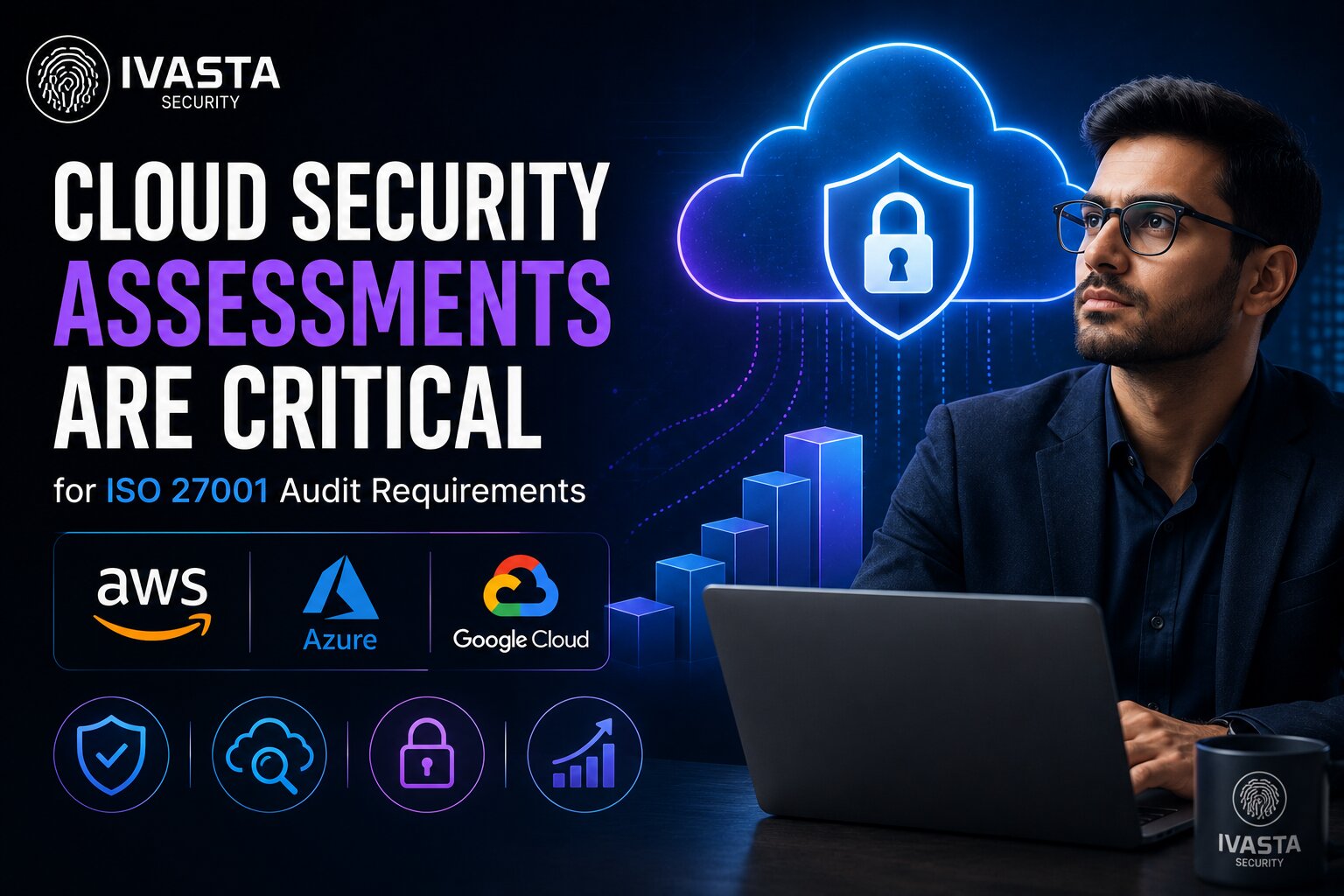
If your organisation runs workloads on AWS, Azure, or GCP and is approaching an ISO 27001 audit, here is what most security teams learn the hard way: passing the audit is not about having cloud infrastructure. It is about proving your cloud security posture is structured, monitored, and evidenced against specific Annex A controls. A cloud security assessment that maps directly to ISO 27001 requirements is the difference between walking into an audit room with confidence and scrambling to explain gaps you did not know existed. Put simply, a structured cloud security assessment on AWS, Azure, and GCP is not optional preparation for ISO 27001. It is the technical foundation the entire audit depends on.
What ISO 27001 Actually Requires from Your Cloud Environment
ISO 27001:2022 is a management framework, but do not let that word "management" mislead you into thinking it is mostly paperwork. For organisations running on cloud platforms, the 2022 revision introduced controls that are specifically and deliberately aimed at how you manage third-party cloud services and the technical vulnerabilities living inside them.
Two controls are particularly relevant for any multi-cloud environment. The first is A.5.23 Information Security for Cloud Services, which requires you to define security requirements for cloud providers, monitor their compliance, and manage changes across services. The second is A.8.8 Management of Technical Vulnerabilities, which demands a systematic process to identify, assess, and remediate vulnerabilities in your cloud infrastructure before an attacker can exploit them.
Neither of these can be satisfied with a checkbox or a vendor certificate. Your cloud provider holding its own ISO 27001 certificate covers the physical infrastructure layer. Under the Shared Responsibility Model, everything above that layer sits squarely on you, including IAM configuration, network controls, encryption practices, logging, and your patch management process across every account and subscription you operate.
Mapping Cloud Security Assessment Findings to ISO 27001 Annex A Controls
The core value of running a structured cloud security assessment across AWS, Azure, and GCP is not just the list of findings you get at the end. It is what those findings represent when you sit in front of an ISO auditor. Each technical finding maps to a specific Annex A control, and each resolved finding becomes an item of audit evidence. The table below shows how the primary controls align across the three major platforms.
A.5.23: Making Your Cloud Provider Relationships Audit-Ready
A.5.23 is the control auditors focus on when they want to understand how you govern multi-cloud posture management. This is not just about having a contract with AWS or Azure. The control expects you to demonstrate active oversight of the cloud services you consume, including evidence that you have assessed the provider, are monitoring their security posture, and have a formal process for responding to changes in their service offerings.
A cloud security assessment aligned to A.5.23 will review whether your cloud accounts are properly scoped, whether your logging is centralised across providers, whether your identity federation is configured correctly, and whether provider compliance certificates are being reviewed on a scheduled basis. These are the exact artefacts your auditor will request.
A.8.8: Technical Vulnerability Management Across Cloud Environments
Control A.8.8 is where cloud security assessments on AWS, Azure, and GCP become directly tied to your audit evidence pack. The standard requires you to identify vulnerabilities in a timely manner, assess their severity, and implement remediation based on risk. On AWS, this maps to running Inspector and Security Hub with defined response SLAs. On Azure, it maps to Microsoft Defender Vulnerability Management integrated with your ticketing workflow. On GCP, it maps to Artifact Analysis findings routed through Security Command Center with documented triage processes.
The critical gap that competitors in this space consistently miss is that running the tools is not sufficient. The auditor needs to see that your team is acting on the findings. A vulnerability assessment that produces a report which then sits in a folder does not satisfy A.8.8. You need a documented workflow: finding identified, severity assessed, remediation owner assigned, remediation completed, retest conducted, evidence filed.
The Multi-Cloud Posture Challenge: Why Single-Cloud Thinking Fails ISO Audits
Most organisations running cloud security assessments approach each platform separately. The security team runs an assessment on AWS and fixes those findings. Then, some weeks later, they look at Azure. GCP, if they operate there, often gets reviewed last, if at all before the audit window closes. This siloed approach creates a specific audit risk.
ISO 27001 expects a unified ISMS that covers your entire information processing environment. When your cloud environment spans multiple providers, the auditor will look for a consistent control baseline across all of them, not three separate assessments with three different risk frameworks and three different evidence formats. This is where multi-cloud posture management becomes a practical audit requirement rather than an architectural ambition.
A properly structured cloud security assessment across AWS, Azure, and GCP should produce findings in a normalised risk format that maps back to a single control set. Whether you discover an overly permissive S3 bucket policy, an Azure Blob Storage container with public access, or a GCP Cloud Storage bucket without uniform bucket-level access, these are all the same A.8.8 and A.5.23 finding in ISO terms. They need to be tracked together, remediated together, and evidenced together.
What ISO Auditors Actually Look For in Cloud Security Evidence
One of the most common reasons cloud-native companies struggle with ISO 27001 surveillance audits is not that they lack security controls. It is that they cannot produce evidence the controls are operating continuously. Here is what a well-prepared ISO evidence pack looks like for each of the primary cloud security controls.
For A.5.23, auditors want to see a documented cloud services policy that names your approved providers, defines data classification requirements for each environment, and includes a record of annual provider certificate reviews. They also expect to see a Data Processing Agreement in place with each major provider and evidence that you monitor provider compliance on an ongoing basis.
For A.8.8, auditors want to see vulnerability scan results from across your cloud estate, evidence of a triage and prioritisation process, and closure records for findings above your defined risk threshold. Critically, they want to see this evidence spanning at least twelve months, not just the two weeks before the audit. This is why continuous evidence collection through tools like AWS Audit Manager, Microsoft Defender for Cloud, and GCP Security Command Center is not optional infrastructure. It is the only practical way to satisfy the ISO audit timeline.
Cloud Security Assessment Evidence Collection: Frequency Guide for ISO 27001
The following schedule represents a practical starting point for organisations building an ISO-aligned evidence collection programme across AWS, Azure, and GCP. Adapt timing to your specific risk profile and control baseline.
How a Cloud Security Assessment Feeds Your ISO 27001 Statement of Applicability
The Statement of Applicability (SoA) is the document that ties your cloud security assessment findings to the ISO 27001 control framework. For each of the 93 Annex A controls, you need to declare whether the control is applicable to your environment, what your implementation is, and why controls that are excluded have been formally accepted as out of scope.
A cloud security assessment is one of the most efficient ways to populate the SoA for technology controls because it provides direct evidence of what is implemented and what is not. When your assessment confirms that MFA is enforced on all privileged accounts across your AWS Organizations and Azure Entra ID, that finding directly substantiates your SoA entry for A.8.5. When the assessment identifies that GCP Data Access Logs are not enabled on sensitive buckets, that is a gap you need to address before you can assert A.8.15 as fully implemented.
This is the connection that most ISO 27001 guidance misses when discussing cloud environments. The cloud security assessment is not a separate exercise from ISO preparation. It is ISO preparation. The findings are your gap analysis. The remediation work is your control implementation. The continuous evidence collection is your ongoing compliance monitoring. Done correctly, a cloud security assessment on AWS, Azure, and GCP produces the raw material your ISMS is built from.
Common Cloud Security Gaps That Cause ISO Audit Failures
IAM Misconfigurations and Privileged Access
Overly permissive IAM policies are the most common finding across cloud security assessments on AWS, Azure, and GCP. From an ISO perspective, these findings map directly to A.8.2 Privileged Access Rights and A.8.5 Secure Authentication. An auditor who finds that production accounts have persistent administrative access with no MFA enforcement will treat this as a major nonconformity, not a minor observation.
Logging Gaps and Retention Failures
ISO 27001 A.8.15 requires logs to be retained and protected from tampering. Organisations often have logging enabled but fail on retention, storing logs for thirty days when the audit evidence period spans twelve months. On AWS, this means S3 Object Lock with COMPLIANCE mode enabled on your CloudTrail bucket. On Azure, this means Immutable Blob Storage for your Log Analytics workspace. On GCP, this means bucket retention policies applied to your Cloud Audit Log sink. A penetration testing engagement that also reviews your logging architecture will surface these gaps before an auditor does.
Missing Vulnerability Management Workflow
Many cloud teams run vulnerability scanning but have no documented process for what happens after a finding is identified. For A.8.8, the scanner output is the beginning, not the end. Without a defined SLA for remediation based on severity, an assigned ownership model, and a closed-loop tracking system, the audit evidence is incomplete. This is the gap that causes the most last-minute scrambling before ISO surveillance audits.
Selecting the Right Approach: Automated Native Tools vs Third-Party Assessment
For organisations that are early in their ISO 27001 journey, the question of whether to rely on native cloud security tools or engage an independent cloud security assessment provider comes up quickly. The answer depends on your current maturity and the nature of your audit scope.
Native tools like AWS Security Hub, Microsoft Defender for Cloud, and GCP Security Command Center are excellent for continuous compliance monitoring once a baseline is established. They provide mapped findings against known frameworks and integrate with your evidence collection workflow. What they do not provide is an independent validation of your configuration decisions, a manual review of business logic, or a finding that requires an attacker perspective to identify.
An independent cloud security assessment across AWS, Azure, and GCP conducted by a certified team adds the layer of verification that ISO auditors and enterprise procurement teams expect. It demonstrates that your posture has been reviewed by someone outside your organisation, with findings documented in a format that can be presented directly as audit evidence. When your SoA states that A.8.8 is fully implemented, an independent assessment report is what makes that statement credible.
If you are preparing for SOC 2 alongside ISO 27001, the overlap in evidence requirements means a single well-scoped cloud security assessment on AWS, Azure, or GCP can serve both audit programmes simultaneously, reducing cost and testing disruption.
Ready to map your cloud environment to ISO 27001 Annex A controls? Get in touch with the IVASTA Security team and request a scoping call. Our certified professionals will review your AWS, Azure, or GCP posture and deliver findings your auditors can act on.