Web Application Penetration Testing
Find the vulnerabilities that automated scanners miss. IVASTA's certified security engineers simulate real-world attackers against your web application, delivering actionable findings, not just a checklist.

Simulating Threats

Streamlining Remediation

Ensuring Compliance
What Is Web Application Penetration Testing
Web application penetration testing is the process of simulating real-world cyberattacks against your web application to uncover exploitable vulnerabilities before malicious actors can. Unlike automated vulnerability scans, our manual penetration testing approach goes deeper, identifying business logic flaws, complex authentication weaknesses, privilege escalation paths, and injection vulnerabilities specific to your application's architecture.
Every web application is unique. That is why IVASTA's testers do not rely primarily on automated scanners. We apply a proven manual methodology, refined over years of hands-on offensive security engagements, to simulate how a real attacker would approach your specific application.

What Our Web Application Penetration Testing Covers
.svg)
Vulnerability Classes We Identify:
- Injection Flaws, SQL injection, NoSQL injection, command injection, LDAP injection
- Broken Authentication & Session Management, weak credentials, session fixation, insecure tokens
- Cross-Site Scripting (XSS), stored, reflected, and DOM-based XSS
- Broken Access Control, IDOR, privilege escalation, forced browsing
- Security Misconfiguration, exposed APIs, default credentials, verbose error messages, open cloud storage
- Sensitive Data Exposure, unencrypted data in transit or at rest, insecure storage
- XML External Entity (XXE) Injection
- Insecure Deserialization, object injection, remote code execution paths
- Server-Side Request Forgery (SSRF)
- API Security Flaws, improper authorisation, rate limiting bypass, mass assignment
- Cryptographic Failures, weak algorithms, hardcoded secrets, improper certificate validation

Our Web Application Penetration Testing Methodology
.svg)
Scoping & Kick-Off
We define the test scope, objectives, environments, threat model, and engagement rules. You choose the testing mode, black box (no prior knowledge), grey box (credentials and partial documentation), or white box (full access including source code). This phase ensures the assessment targets what matters most to your business.
Reconnaissance & Attack Surface Mapping
Our engineers enumerate all accessible endpoints, map the application's architecture, identify technology stack components, and document the full attack surface, including third-party integrations and API interfaces.
Automated Scanning (Surface Pass)
We run selective automated tooling to quickly surface known vulnerability signatures and common misconfigurations. Findings are reviewed and validated manually before being included in the report, we never deliver raw scanner output.
Manual Penetration Testing
This is the core of the engagement. Our certified security engineers manually probe authentication flows, access controls, input handling, session management, and business logic, simulating how a real attacker would chain vulnerabilities together to achieve a meaningful impact.
Exploitation & Impact Validation
Where safe and within scope, vulnerabilities are exploited to demonstrate their real-world impact. This eliminates false positives and gives your team unambiguous evidence of risk severity.
Reporting & Remediation Guidance
You receive a detailed, dual-audience report: an executive summary with business-level risk context, and a full technical report with step-by-step reproduction steps, CVSS scores, and prioritised remediation guidance. Every finding is written so your developers can act on it immediately.
Free Retest & Security Attestation Letter
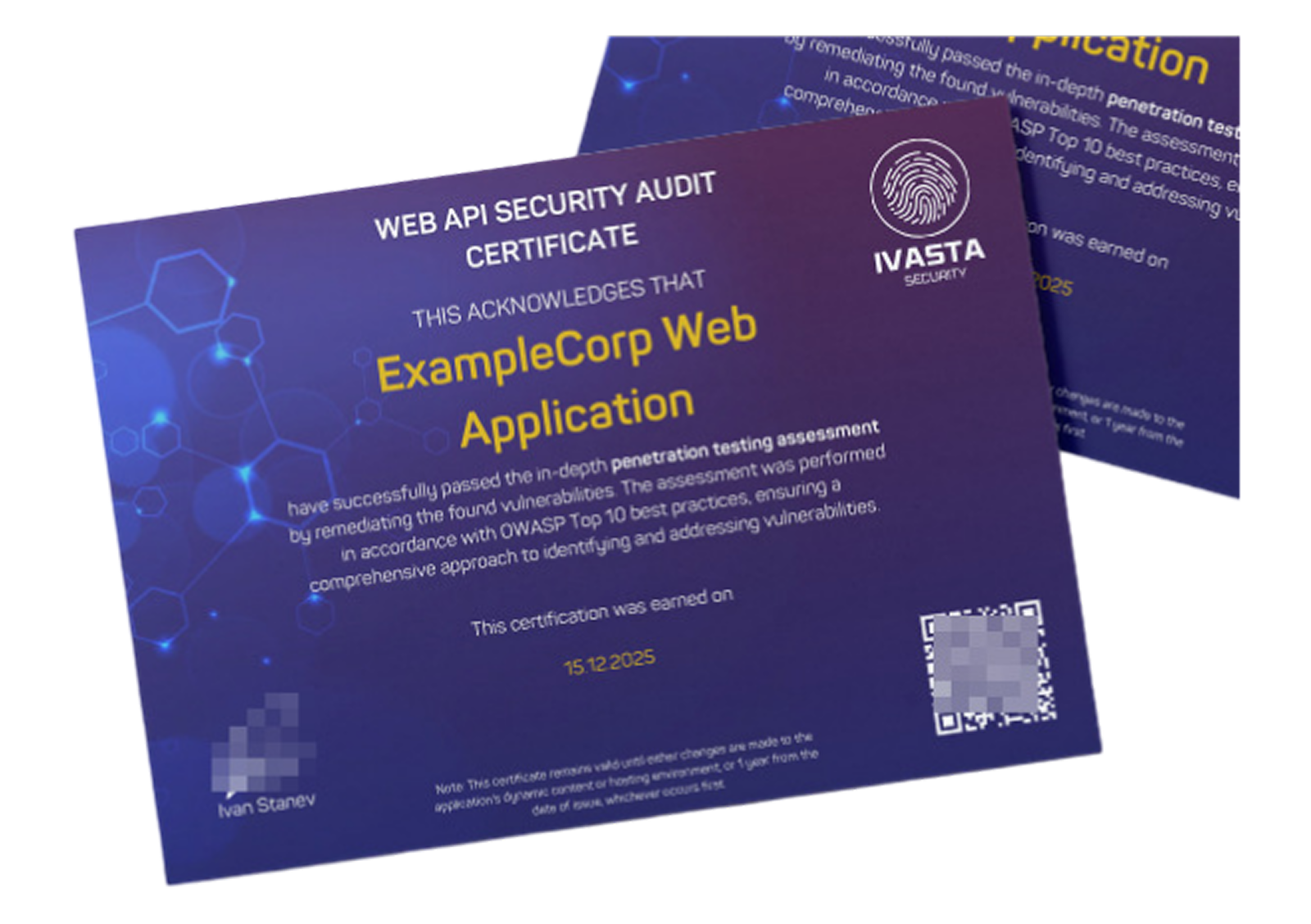
After remediation, we verify that identified vulnerabilities have been correctly resolved at no additional cost. Upon successful completion, we issue a signed digital certificate confirming remediation, a deliverable to the clients, auditors, or investors may request.
Black Box, Grey Box & White Box Penetration Testing
The right testing mode depends on your goals, what information you can provide, and your compliance requirements. IVASTA supports all three approaches.
Black Box Testing
No prior knowledge of the application is shared. Our testers approach the target exactly as an external attacker would, with only the URL and publicly available information. Best suited for realistic attack simulation and red team exercises.
Grey Box Testing
You provide test credentials and, optionally, partial documentation. This is the most effective mode for most organisations, it eliminates reconnaissance time, allowing our engineers to focus on testing actual application logic within a defined timeframe. Recommended for most web application penetration testing engagements.
.svg)
White Box Testing
Full access is granted, including source code and architecture documentation. Our engineers can trace vulnerabilities directly in code, delivering the highest possible coverage. Ideal for product-level security reviews and pre-launch assessments.
Web Application Penetration Testing for SOC 2, PCI DSS & GDPR Compliance
The AICPA Trust Services Criteria for Security require that organisations demonstrate proactive vulnerability management and testing of controls. A penetration test conducted by an independent firm, with a clear methodology and a dated report, is widely accepted as evidence of operational security controls under SOC 2 Type II. IVASTA's reports are structured to map directly to the CC6 and CC7 control categories, making audit preparation straightforward.
PCI DSS Requirement 11.4 mandates penetration testing of all in-scope systems and applications on at least an annual basis, and after any significant infrastructure change. Our testing methodology is aligned with PCI DSS v4.0 requirements, covering both network-layer and application-layer assessments.
Under GDPR Article 32, data controllers and processors are required to implement appropriate technical measures to ensure the security of personal data, including regular testing and evaluation of those measures.
Why Choose IVASTA for Web Application Penetration Testing?
Manual-First Approach
We simulate real attackers, not real scanners. Our engagements are led by experienced, certified security engineers who apply creative, hands-on testing, not automated tools repackaged as a professional service. Business logic vulnerabilities, chained attack paths, and context-specific abuse cases are only discoverable through genuine manual testing.
Certified, Experienced Engineers
Our team holds certifications including OSCP (Offensive Security Certified Professional), CEH (Certified Ethical Hacker), and CREST. More importantly, our testers have real-world offensive experience, they know how actual attackers think and work.
No Jargon. Clear Remediation.
Every finding in our report is written for two audiences: your developers need step-by-step reproduction steps; your board needs business impact context. We ensure both get what they need. No cryptic scanner output. No vague recommendations.
Free Retest Included
Fixing a vulnerability is only valuable if the fix actually works. Every IVASTA Security engagement includes a complimentary retest to validate that identified issues have been correctly remediated.
Fast Turnaround, Clear Communication
From initial scoping to final report delivery, we keep you informed at every step. Critical findings are flagged immediately, not saved for the final report. Typical engagements are delivered within an agreed timeline, and we do not miss deadlines.
Signed Security Attestation Letter
Upon successful completion and retest, we issue a digitally signed letter confirming your application was assessed by our team. This is a tangible deliverable you can present to customers, investors, and compliance auditors.
What You Receive
.svg) Executive Summary, business-level risk overview for non-technical stakeholders
Executive Summary, business-level risk overview for non-technical stakeholders.svg) Full Technical Report, every finding with title, severity (CVSS score), description, reproduction steps, evidence (screenshots), and remediation guidance
Full Technical Report, every finding with title, severity (CVSS score), description, reproduction steps, evidence (screenshots), and remediation guidance.svg) Vulnerability Risk Matrix, prioritised list of all findings with effort-to-fix vs. impact mapping.
Vulnerability Risk Matrix, prioritised list of all findings with effort-to-fix vs. impact mapping..svg) Free Retest, verify all critical and high-severity findings are remediated
Free Retest, verify all critical and high-severity findings are remediated Security Attestation Letter, signed confirmation of completed assessment
.svg) Debrief Call, walk-through of findings with your development and security teams
Debrief Call, walk-through of findings with your development and security teams
Ready to Secure Your Web Application?
Retest Assessment
An optional retest verifies that identified vulnerabilities have been correctly remediated and are no longer exploitable, with a digitally signed verification certificate issued upon successful completion.
See What We Can Do For You
Our Methadology
Lorem ipsum dolor sit amet consectetur adipiscing eli mattis sit phasellus mollis sit aliquam sit nullam.
Lorem ipsum dolor sit amet consectetur adipiscing eli mattis sit phasellus mollis sit aliquam sit nullam.Lorem ipsum dolor sit amet consectetur adipiscing eli mattis sit phasellus mollis sit aliquam sit nullam.Lorem ipsum dolor sit amet consectetur adipiscing eli mattis sit phasellus mollis sit aliquam sit nullam.
Frequently Asked Questions
What is web application penetration testing?
.svg)
Web application penetration testing is the process of engaging certified security engineers to simulate real-world cyberattacks against your web application. The goal is to identify exploitable vulnerabilities, including OWASP Top 10 issues and business logic flaws, before malicious actors find them. Unlike automated vulnerability scanning, manual penetration testing can discover complex, chained attack paths that require human reasoning to uncover.
How is manual penetration testing different from automated scanning?
Automated vulnerability scanners search for known signatures and common misconfigurations quickly. They are useful for initial triage but routinely miss business logic vulnerabilities, authentication bypass chains, IDOR flaws, and application-specific abuse cases. Manual penetration testing, as performed by IVASTA's engineers, simulates how a skilled human attacker approaches your application, following logical paths, chaining weaknesses, and applying creative reasoning that no scanner can replicate.
How long does a web application penetration test take?
The duration depends on the size and complexity of the application. A focused assessment of a single-feature web application may take 3–5 days. A large, multi-role SaaS platform with complex workflows, multiple API surfaces, and authenticated roles may require 2–3 weeks. During scoping, IVASTA will provide a fixed timeline based on your specific application. We do not commence testing until the scope and timeline are agreed in writing.
How much does web application penetration testing cost?
Pricing is scoped to your engagement and depends on the application's size, complexity, number of roles, API coverage, and testing mode (black box, grey box, or white box). Rather than publish a generic price list, we prefer to scope each engagement accurately and provide a fixed-price quote, so you know exactly what you are paying for. Contact us for a scoping call and we will provide a quote within 24 hours.
Do I need penetration testing for SOC 2 compliance?
While SOC 2 does not mandate penetration testing by name, the AICPA's Trust Services Criteria (particularly CC6 and CC7) require organisations to demonstrate ongoing testing and monitoring of security controls. In practice, independent penetration testing is the most widely accepted evidence for these controls during a Type II audit. If you are working with an auditor or preparing for a SOC 2 certification, IVASTA's report format is structured to align with these requirements.
Does PCI DSS require web application penetration testing?
Yes. PCI DSS Requirement 11.4 explicitly requires penetration testing of all in-scope systems at least annually and after significant changes. Both internal and external testing is required, covering both network and application layers. IVASTA's PCI DSS penetration testing engagements are scoped to satisfy these requirements and are structured to produce a report your QSA will accept.
How does penetration testing support GDPR compliance?
GDPR Article 32 requires organisations to implement technical measures to ensure the ongoing confidentiality and integrity of personal data processing systems, and to regularly test and evaluate those measures. A documented web application penetration test provides written evidence that you have proactively assessed your application for vulnerabilities that could lead to a personal data breach. In the event of an incident or regulatory investigation, this evidence demonstrates that your organisation took its security obligations seriously.
What happens after the penetration test?
After the assessment, you receive a full technical report and an executive summary. Our team will walk you through the findings in a debrief call. Once your team has remediated the identified vulnerabilities, IVASTA performs a free retest to confirm the fixes are effective. Upon successful completion, we issue a signed security attestation letter confirming the assessment.
What information do I need to provide for a web app pentest?
This depends on the testing mode you select. For grey box testing (our most common engagement type), you typically need to provide: the application URL, test account credentials for each user role, a brief description of core functionality and any known sensitive areas, and written confirmation of scope and authorisation. We handle the rest from there.
Will the penetration test affect my live application?
IVASTA conducts testing in a controlled manner to avoid disrupting live services. We discuss testing windows and any restrictions during scoping, if you have specific availability requirements (for example, avoiding peak trading hours), these are built into the engagement plan. For production environments, we avoid destructive testing unless explicitly authorised. Wherever possible, we recommend using a staging environment that mirrors production closely.
Let's Protect Your
Business Now!